| |

|
| |
Dear IMPRI Well-wishers,
Greetings!
This week at IMPRI, we bring sharp, timely insights on global and domestic affairs. TK Arun analyzes Western strategic dominance in the Israel-Iran conflict, while Arun Kumar reflects on the long-term impact of India’s Emergency. Tikender Singh Panwar questions Punjab’s urban expansion, and Arun Kumar highlights the Global South’s quiet resistance to unfolding imperialism.
IMPRI is pleased to announce the launch of the Diplomacy, Foreign Policy & Geopolitics Youth Fellowship (DFPGYF) – Cohort 2.0, an immersive online international autumn school program running from July to October 2025. Organized by the IMPRI Center for International Relations and Strategic Studies, this four-month certificate training fellowship is designed to equip young professionals, students, and global affairs enthusiasts with foundational knowledge and leadership skills in international relations.
Stay tuned and scroll below for more updates and upcoming engagements at IMPRI!
Dr Simi Mehta, CEO & Editorial Director, IMPRI
|
|
| |
|
|
| |
|
|
| |
Examining the Feasibility of an East-West Economic Corridor for South and Central Asia:
Views from India and Pakistan
In this exploratory report, the authors ask whether an East-West Economic Corridor (EWEC) linking Afghanistan, the Central Asian republics (Kazakhstan, Kyrgyzstan, Tajikistan, Turkmenistan, and Uzbekistan), India, Iran, and Pakistan is feasible. Earlier efforts to develop economic corridors in this region have failed. The causes, the authors find, do not lie in doubts about the corridors' economic viability. Instead, the causes appear to be geopolitical alignments, internal conflicts, relations between EWEC members, great-power relations of EWEC members, and barriers to external capital.
|
|
| |
|
|
|
|
|
| |
While the increased allocation for urban transformation appears promising, this article critically examines its effectiveness in building inclusive cities. The analysis argues for rethinking urban policymaking based on theempowerment of city governments, strengthening municipal capacities, and integrating the urban poor’s needs into urban planning mechanisms.
by Soumyadip Chattopadhyay & Arjun Kumar
|
|
|
|
| |
Latest Insight Articles
|
|
|
| |
| |
The Human and Strategic Costs of a US Strike on Iran
The relevance of G7 and BRICS figures among the casualties list, but not Iranian nuclear capability; how should India react in this situation?
by TK Arun
|
|
| |
|
| |
Upcoming #WebPolicyLearning Events
Register to attend
|
|
|
| |

|
|
| |
This immersive fellowship focuses on qualitative participatory action research, allowing participants to engage deeply with real-world public policy challenges. Through expert-led sessions that blend theory with hands-on practice, participants will participate in workshops, networking sessions, and group projects, equipping them to navigate complex policy landscapes and craft evidence-based solutions.
|
| |
|
| |
| |
Building on its successful initiatives in Diplomacy and Foreign Policy, IMPRI, through the IMPRI Center for International Relations and Strategic Studies is thrilled to announce the second cohort of the Diplomacy, Foreign Policy & Geopolitics Youth Fellowship (DFPGYF) for future leaders in international relations.
|
| |
|
|
|
| |
Latest Books & Reports
|
|
|
| |
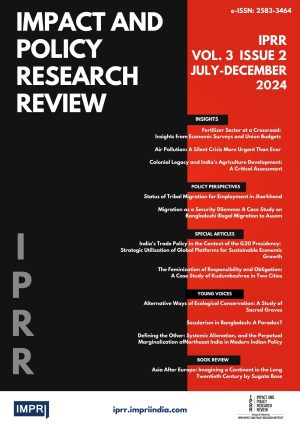
IPRR Vol. 3 Issue 2 (July-Dec 2024)
|
|
| |
Impact and Policy Research Review (IPRR) (e-ISSN: 2583-3464) is a biannual research journal managed and published by IMPRI Impact and Policy Research Institute, New Delhi. IPRR is an open-access journal.
|
| |
|
Thank you for your continued encouragement and support towards our efforts in carrying out serious research.
|
|