|
A weekly roundup of the latest at IMPRI! ͏ ͏ ͏ ͏ ͏ ͏ ͏ ͏ ͏ ͏ ͏ ͏ ͏ ͏ ͏ ͏ ͏ ͏ ͏ ͏ ͏ ͏ ͏ ͏ ͏ ͏ ͏ ͏ ͏ ͏ ͏ ͏ ͏ ͏ ͏ ͏ ͏ ͏ ͏ ͏ ͏ ͏ ͏ ͏ ͏ ͏ ͏ ͏ ͏ ͏ ͏ ͏ ͏ ͏ ͏ ͏ ͏ ͏ ͏ ͏ ͏ ͏ ͏ ͏ ͏ ͏ ͏ ͏ ͏ ͏ ͏ ͏ ͏ ͏ ͏ ͏ ͏ ͏ ͏ ͏ ͏ ͏ ͏ ͏ ͏ ͏ ͏ ͏ ͏ ͏ ͏ ͏ ͏ ͏ ͏ ͏ ͏ ͏ ͏ ͏ ͏ ͏ ͏ ͏ ͏ ͏ ͏ ͏ ͏ ͏ ͏ ͏ ͏ ͏ ͏ ͏ ͏ ͏ ͏ ͏ ͏ ͏ ͏ ͏ ͏ ͏ ͏ ͏ ͏ ͏ ͏ ͏ ͏ ͏ ͏ ͏ ͏ ͏ ͏ ͏ ͏ ͏ ͏ ͏ ͏ ͏ ͏ ͏ ͏ ͏ ͏ ͏ ͏ ͏ ͏ ͏ ͏ ͏ ͏ ͏
| |
| |
This Week at #IMPRI
(2021 | W17 | April 26 - May 2)
|
|
| |
|
|
Dear IMPRI Well-wisher,
Greetings from the team and we hope you and your family members are healthy amidst the deadly second wave, having catastrophic impact on our lives.
Amid the extended lockdowns and focus to break the chain of the mutated virus spread, the challenges of health, safety and livelihood have taken the center stage. The uncertain weeks ahead and the plight of sad news has affected the mental health of people at home impacting their health and productivity.
The newsletter will apprise you of these upcoming events, the week's publications, and videos of past week's #WebPolicyTalks in case you missed them. We hope to see you soon at one of our events!
Wishing you a safe week ahead,
Anshula Mehta, Assistant Director, IMPRI
|
|
|
Upcoming #WebPolicyTalks
Register to attend!
|
|
|
|
Panel Discussion
| |

|
Panel Discussion on Reverse Migration amidst Second Wave of Coronavirus Pandemic: Challenges and Solutions
When: April 26, 2021 | 6 PM
REGISTER HERE
Panelists: Prof Arun Kumar (Institute of Social Sciences, New Delhi); Prof Irudaya Rajan (International Institute of Migration and Development (IIMAD), Kerala); Ms Akriti Bhatia (People’s Association In Grassroots Action and Movement (PAIGAM)); Tikender Singh Panwar (IMPRI, New Delhi)
|
|
|
|
#WaterandClimate
| |

|
Dr Anjal Prakash (Research Director and Adjunct Associate Professor, Indian School of Business (ISB), Hyderabad) on Water and Climate Change: Challenges for India
When: April 27, 2021 | 4:00 PM IST | REGISTER HERE
Moderated by Dr Indira Khurana, Senior Expert, Water Sector, Vice-Chair, Tarun Bharat Sangh, Alwar
|
|
|
|
Special Lecture
| |

|
Women’s Representation in India
Speaker: Prof Ranjana Kumari (Director, Centre for Social Research, New Delhi)
When: April 28, 2021 | 3:00 PM IST | REGISTER HERE
Chair: Prof Vibhuti Patel (Former Professor, TATA Institute of Social Sciences, Mumbai)
|
|
|
|
#InclusiveDevelopment Book Discussion
| |
|
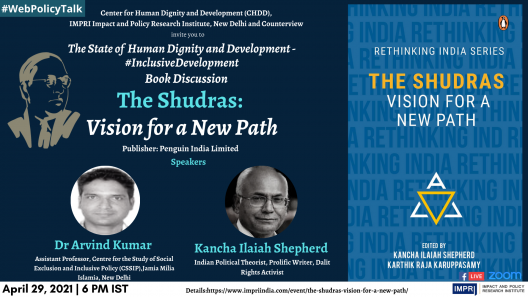
Prof Kancha Ilaiah Shepherd (Indian Political Theorist, Prolific Writer, Dalit Rights Activist; Former Director, Centre for the Study of Social Exclusion and Inclusive Policy, Maulana Azad National Urdu University, Hyderabad) and Dr Arvind Kumar (Assistant Professor, Centre for the Study of Social Exclusion and Inclusive Policy (CSSIP), Jamia Milia Islamia (JMI), New Delhi) on The Shudras: Vision for a New Path
When: April 29, 2021 | 6:00 PM IST | REGISTER HERE
Discussants: Dr Ajay Gudavarthy (Jawaharlal Nehru University (JNU), New Delhi); Dr Aakash Singh Rathore (Professor, author and an Ironman triathlete)
|
|
|
|
Panel Discussion
| |

|
Panel Discussion on Forest Fires: Exploring the Solutions
When: April 30, 2021 | 11:30 AM IST | REGISTER HERE
Panelists: Prof Anil K Gupta (National Institute of Disaster Management (NIDM)), Maj Gen Manoj K Bindal (NIDM), Dr Simi Mehta (IMPRI), Tikender Singh Panwar (IMPRI), Prof Amita Singh (NASPISAG, JNU), Shri Mohan Chandra Pargaien IFS
|
|
|
|
Book Discussion
| |

|
The Rock Babas and Other Stories
Ameya Prabhu, Author; Partner, UAP Advisors LLP, Mumbai
When: April 30, 2021 | 6:00 PM IST | REGISTER HERE
|
|
|
|
Panel Discussion
| |

|
On the occasion of International Workers Day
Migrant Workers, Labour Rights and Policy: Impact and Way Forward
When: May 1, 2021 | 5:00 PM IST | REGISTER HERE
Chaired by Dr Denzil Fernandes (Indian Social Institute, New Delhi) and moderated by Prof K R Shyam Sundar (XLRI)
|
|
|
|
| |

|
Strategic and Effective Lockdown: Only Impactful Solution to the Second Wave by Arun Kumar | #IMPRI insights
The Prime Minister, in his short recent address to the nation, used the imagery of a ‘toofan’ and admitted that India has been hit by a frightening surge of COVID-19 cases. There is a near collapse of the health infrastructure, with horror stories coming from all around the country of people dying due to lack of hospital beds, oxygen and so on – the nation is literally gasping for breath. These are the reports from the metro cities, which are far better medically equipped than the smaller towns and villages. At this time 3 weeks a strategic and effective lockdown.
|
|
|
|
| |

|
Majoritarian Mindset Adversely Impacting COVID 2nd Wave Governance
by Ajay Gudavarthy | #IMPRI insights
Given that all those who endorsed majoritarianism and believed in the ‘supreme leader’ are also at the receiving end now, they do not know who to blame, except to hallucinate that things are either not that bad or will get better soon. The majoritarian psyche is at the heart of our failure to fight the pandemic. Majoritarianism, unlike what the nomenclature suggests, excludes the majority of the population in favour of a tiny minority. It is this sanction to exclude without a sense of fairness that the persona of Narendra Modi represents, and something society trusted and celebrated, is the reason why today we are failing to fight a pandemic that requires collective responsibility and compassionate mutuality.
|
|
|
|
| |

|
Bold Vaccination Policy Needed
by T K Arun | #IMPRI insights
The government has announced some changes to its vaccine policy, allowing more companies to produce more COVID vaccines, developed locally or abroad, and allowing them to sell half their output at a price that is higher than the Centre’s current procurement price. In an earlier installment of policy reform, the government had decided to fast-track local authorization of foreign vaccines approved by competent regulators abroad and to fund expansion of vaccine and vaccine ingredient capacity. There is a Bold Vaccination Policy Needed for Victory over COVID-19.
|
|
|
|
| |

|
Prioritizing Migrant Workers’ Health, Safety & Welfare by Irudaya Rajan | #IMPRI insights
The Indian government imposed a nationwide 21-day lockdown on March 23, 2020, As a preventive measure against the COVID-19 pandemic. The nationwide lockdown continued until May 3, after which it was extended with conditional relaxations until May 31. The economy slowly started reverting with Unlock 1.0 being announced on June 1. Today, almost a year later, COVID-19 vaccines are being rolled out across the nation. This article locates the need to prioritize migrant worker’s health, safety, and welfare during the pandemic.
|
|
|
|
Event Report: Infrastructuring the City: Trajectories of Violence by Soumyadip Chattopadhyay, Arjun Kumar | IMPRI
There is structural violence that is inherent in our society on account of infrastructure projects worldwide. IMPRI Impact and Policy Research Institute as part of its series #CityConversations organized a lecture with Dr. Deljana Iossifova titled Infrastructuring the City: Trajectories of Violence. Dr. Deljana Iossifova is a Senior Lecturer, Urban Studies and Director, Confucius Institute, University of Manchester United Kingdom. She is also the Chair of the Urban Studies Foundation.
Event Report: Uses and Abuses of Statistics by Utpal K De, Arjun Kumar | IMPRI
Everyone is well aware of the uses of statistics – how data is used to reveal some facts like changes of some variables over time and across communities depending on various aspects of society. Also, data is used to correlate various factors and form welfare policies. However, there are several abuses of statistics too. For example, a positive change in any aspect might directly be credited to its respective policy. However, we ignore the other side impacts or external factors due to which the change might have occurred. If one excludes these factors, one might realize that the policy, by itself, might have had minimal impact. To discuss the fallacies and misinterpretation of statistics, Genalpha DC at IMPRI Impact and Policy Research Institute, New Delhi organised an IMPRI Special Lecture – The State of Statistics – #DataDiscourses on Uses and Abuses of Statistics by Prof Manoranjan Pal, a former Professor at the Economic Research Unit, and former Director of International Statistical Education Centre, Indian Statistical Institute (ISI), Kolkata.
Event Report: How to enable SMEs to penetrate the Global Value Chains of Transnational Corporations (TNCs)? The Need to Strengthen Regional Innovation Systems by Arjun Kumar, Ritika Gupta | IMPRI
MSMEs are key drivers of innovation, economic growth, and new employment generation, making them a key demographic constituent to measure the economic health of countries globally. And with Globalization of industries happening at a fast pace it will be critical for the growth of MSMEs to look into aspects of accessing the market potential offered by the global integration in the joint talk organized by Centre for Work and Welfare (CWW), IMPRI Impact Policy and Research Institute, New Delhi, counterview and working papers charter.
'Statistics: If one only studies uses and not abuses, one might be misguided' by Utpal K De, Arjun Kumar | Counterview
Without having knowledge or using common sense, if we directly just use the data to reach a conclusion, it’s possible we present a wrong interpretation of the data. This will, in turn, lead to wrong outcomes and policy formulation. Growth of two rupees to four rupees exhibits a 100% growth and zero to one shows an infinite rate of growth. This shows that one has to be very meticulous, methodical and understand the actual relationship among variables.
'Rural Dalits Did Not Benefit from Post-Independence Land Reforms' | Delhi Post News
Commenting on the acquisition, Professor Nancharaiah said, “While the land reforms were able to eradicate the class of zamindars and jagirdars in one way, they were not able to redistribute land equally among the landless.” He quoted data acquired from the National Sample Survey Office (NSSO) over the last 50 years and stated that even though a large number of SC members continue to work in the agricultural sector, most of them work not as cultivators, but as agricultural laborers on other people’s farms.
|
|
|
| |

|
Recognizing the Migrant: Strengthening the Draft National Policy on Migrant Workers
by Priya Deshingkar | #IMPRI insights
The Niti Aayog’s draft Migrant Labour Policy is a clear statement of intent to better recognize migrants’ contribution to the economy and support them in their endeavor. It puts forward several radical ideas, including the adoption of a rights-based approach and establishing an additional layer of institutions to create a more enabling policy environment for migrants.
|
|
|
|
| |

|
Saving Uttarakhand from Wildfires
by Gurinder Kaur | #IMPRI insights
The state of Uttarakhand had not yet emerged from the wounds of the Chamoli tragedy when it was engulfed in wildfires. According to the Forest Department of Uttarakhand, from January to the first week of April 2021, there have been about 1800 incidents of forest fires in the state affecting more than 2500 hectare of forest area. In the first five days of April, wildfires increased so fast that an area of 567 hectare was affected.
|
|
|
|
| |

|
Delhi State Governance Conundrum: Amendments to Centre’s GNCTD Bill are Retrogressive by Tikender Singh Panwar | #IMPRI insights
In the guise of a Supreme Court order dated July 4, 2018, where the court delved upon the subject of powers between the elected legislature and the LG, the central government said it is carrying forward the directions of the SC. This is, however, not true and is the inverse of the SC order. The SC order came in the wake of an appeal by the Delhi government against the Delhi High Court order dated August 4, 2016. It ruled that the LG of Delhi exercised “complete control of all matters regarding National Capital Territory (NCT) of Delhi.”
|
|
|
|
| |

|
Destroying Academic Autonomy
by Arun Kumar | #IMPRI insights
Indian Institute of Mass Communication (IIMC) faculty are protesting the new code of conduct being imposed on them. Under the new rules there can be no protest or criticism, or petitions to higher authorities. With this, what autonomy will the faculty be left with? Delhi University faculties are currently discussing the implementation of the New Education Policies (NEP), one of whose key aspects is autonomy in institutions of higher learning. The key concern is if there is a systematic attempt to destroy academic autonomy?
|
|
|
|
| |

|
#InclusiveDevelopment: Dr Aakash Singh Rathore
(Philosopher, Author, Ironman triathlete) on The Constitution as Revolution: The Vision of B.R. Ambedkar's Preamble
Chaired by Prof Vivek Kumar (Jawaharlal Nehru University (JNU), New Delhi) with discussant Dr Scott Stroud (Moody College of Communication, The University of Texas, Austin)
|
|
|
|
| |

|
#EducationDialogue: Dr Samuel Woolley (Moody College of Communication, The University of Texas at Austin) on The Role of Emerging Technology in Social and Political Maneuvering: Challenges and Solutions
Moderated by Dr Simi Mehta (IMPRI, New Delhi)
|
|
|
|
| |

|
#InclusiveDevelopment: Dr Lata Pratibha Madhukar (Convenor, Bahujan Sanvad Social Channel) on जातिभेद के कारण लिंगभाव और पितृसत्ता की समाज पर पकड
Chair: Prof Vibhuti Patel (TISS, Mumbai)
Discussants: Dr B Rajeshwari
|
|
|
|
| |

|
#TowardsAccountability: Dr Munawer Khwaja (Fiscal Economist, Former Technical Advisor, Fiscal Affairs Department, International Monetary Fund) on Are We in Good Hands? Is Tax Administration in India Following Good International Practices?
Chair: Prof Atul Sarma (Council for Social Development (CSD), New Delhi)
Discussants: Mr Ashok Sinha IRS (Retired Vice Chairman of the Tax Settlement Commission) Dr Indira Iyer (National Council of Applied Economic Research (NCAER), New Delhi, Former IRS and Ex-Director, Tax Policy Research Unit, Ministry of Finance)
|
|
|
| |
| |
Thank you for your continued encouragement and participation in our endeavours, and for your meaningful support towards our efforts in carrying out serious research. |
|
| |
|
|
| |
| |
IMPRI, a startup research think tank, is a platform for pro-active, independent, non-partisan and policy-based research. It contributes to debates and deliberations for action-based solutions to a host of strategic issues. IMPRI is committed to democracy, mobilization and community building. |
|
| |
|
|
|


