|
A weekly roundup of the latest at IMPRI! ͏ ͏ ͏ ͏ ͏ ͏ ͏ ͏ ͏ ͏ ͏ ͏ ͏ ͏ ͏ ͏ ͏ ͏ ͏ ͏ ͏ ͏ ͏ ͏ ͏ ͏ ͏ ͏ ͏ ͏ ͏ ͏ ͏ ͏ ͏ ͏ ͏ ͏ ͏ ͏ ͏ ͏ ͏ ͏ ͏ ͏ ͏ ͏ ͏ ͏ ͏ ͏ ͏ ͏ ͏ ͏ ͏ ͏ ͏ ͏ ͏ ͏ ͏ ͏ ͏ ͏ ͏ ͏ ͏ ͏ ͏ ͏ ͏ ͏ ͏ ͏ ͏ ͏ ͏ ͏ ͏ ͏ ͏ ͏ ͏ ͏ ͏ ͏ ͏ ͏ ͏ ͏ ͏ ͏ ͏ ͏ ͏ ͏ ͏ ͏ ͏ ͏ ͏ ͏ ͏ ͏ ͏ ͏ ͏ ͏ ͏ ͏ ͏ ͏ ͏ ͏ ͏ ͏ ͏ ͏ ͏ ͏ ͏ ͏ ͏ ͏ ͏ ͏ ͏ ͏ ͏ ͏ ͏ ͏ ͏ ͏ ͏ ͏ ͏ ͏ ͏ ͏ ͏ ͏ ͏ ͏ ͏ ͏ ͏ ͏ ͏ ͏ ͏ ͏ ͏ ͏ ͏ ͏ ͏ ͏
| |
| |
This Week at #IMPRI
(2021 | W16 | April 19 - 25)
|
|
| |
|
|
Dear IMPRI Well-wisher,
Greetings from the team!
Amid the rapid surge in coronavirus cases, and a mutated COVID-19 strain, it remains imperative, more than ever, to strictly adhere to all safety precautions, and, wherever applicable, lockdown guidelines. With low availability of beds and oxygen, safety and prevention assume paramount importance in navigating through this health crisis.
The newsletter will apprise you of these upcoming events, the week's publications, and videos of past week's #WebPolicyTalks in case you missed them. We hope to see you soon at one of our events!
Wishing you a safe week ahead,
Anshula Mehta, Assistant Director, IMPRI
|
|
|
Upcoming #WebPolicyTalks
Register to attend!
|
|
|
|
#InclusiveDevelopment
| |
|
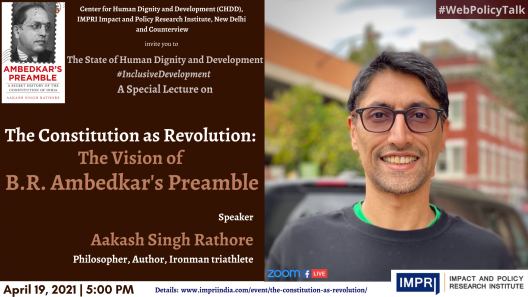
Aakash Singh Rathore (Philosopher, Author, Ironman triathlete) on The Constitution as Revolution: The Vision of B.R. Ambedkar’s Preamble
When: April 19, 2021 (Monday); 17:00 IST | REGISTER HERE
Chaired by Prof Vivek Kumar (Jawaharlal Nehru University, New Delhi), with discussants Dr Scott Stroud (University of Texas at Austin) and Dr Umakant (Independent Scholar), and moderator Dr Simi Mehta (IMPRI)
|
|
|
|
#EducationDialogue
| |
|
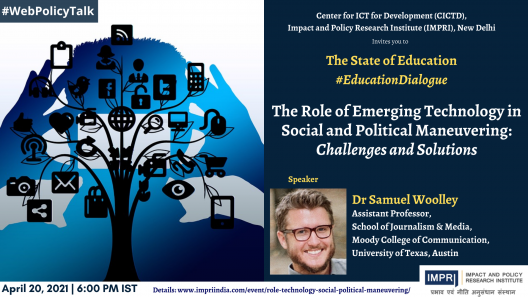
Dr Samuel Woolley (Assistant Professor, School of Journalism & Media; Program Director & Knight Faculty Fellow, Center for Media Engagement, Moody College of Communication, The University of Texas at Austin) on The Role of Emerging Technology in Social and Political Maneuvering: Challenges and Solutions
When: April 20, 2021 (Tuesday); 18:00 IST | REGISTER HERE
|
|
|
|
Special Lecture
| |
|
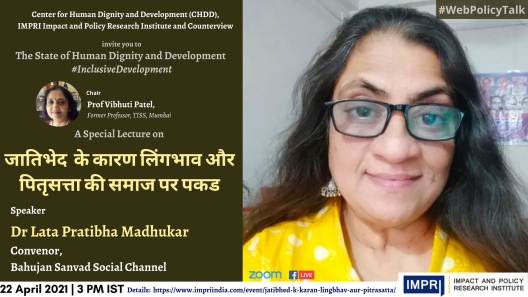
जातिभेद के कारण लिंगभाव और पितृसत्ता की समाज पर पकड
Speaker: Dr Lata Pratibha Madhukar (Convenor, Bahujan Sanvad Social Channel)
When: April 22, 2021 (Thursday); 15:00 IST | REGISTER HERE
Chair: Prof Vibhuti Patel (Retired Professor, TATA Institute of Social Sciences, Mumbai)
|
|
|
|
#TowardsAccountability
| |

|
Dr Munawer Khwaja (Fiscal Economist, Former Technical Advisor, Fiscal Affairs Department, International Monetary Fund) on Are We in Good Hands? Is Tax Administration in India Following Good International Practices?
When: April 22, 2021 (Thursday); 18:00 IST | REGISTER HERE
Chaired by Prof Atul Sarma (Institute for Studies in Industrial Development (ISID), New Delhi) with discussants Prof Indira Iyer (National Council of Applied Economic Research (NCAER), New Delhi) and Ashok Sinha (Formerly, Indian Revenue Service)
|
|
|
|
#GenderGaps Special Lecture
| |
|
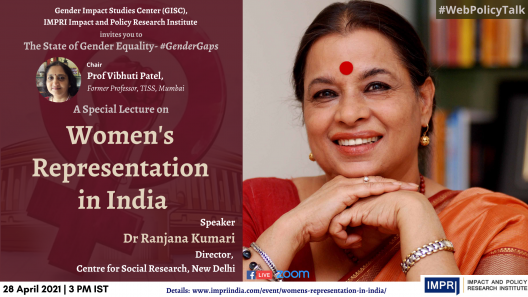
Dr Ranjana Kumari (Director, Centre for Social Research, New Delhi) on Women’s Representation in India
When: April 28, 2021 (Wednesday); 15:00 IST | REGISTER HERE
Chaired by Prof Vibhuti Patel (Formerly, TISS, Mumbai)
|
|
|
|
#InclusiveDevelopment Book Discussion
| |
|
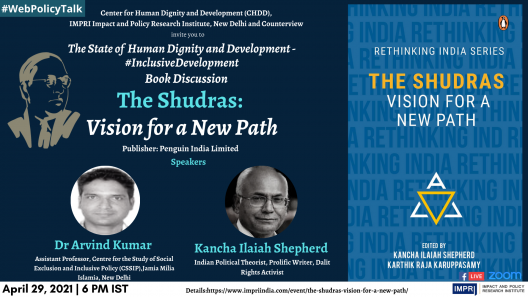
Prof Kancha Ilaiah Shepherd (Indian Political Theorist, Prolific Writer, Dalit Rights Activist) on The Shudras: Vision for a New Path
When: April 29, 2021 (Thursday); 18:00 IST | REGISTER HERE
Moderated by Dr Arvind Kumar (Assistant Professor, Jamia Milia Islamia (JMI), New Delhi)
|
|
|
|
#CityConversations
| |
|
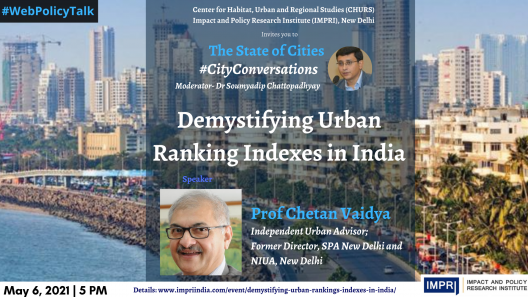
Prof Chetan Vaidya (Independent Urban Advisor; Former Senior National Urban Adviser, Sustainable Urban Development Smart City (SUD-SC) Project Kochi supported by GIZ; Former Director, SPA New Delhi and NIUA, New Delhi) on Demystifying Urban Ranking Indexes in India
When: May 6, 2021 (Thursday); 17:00 IST | REGISTER HERE
Chaired by Hitesh Vaidya (Director, National Institute of Urban Affairs (NIUA), Delhi)
|
|
|
|
#DataDiscourses
| |
|
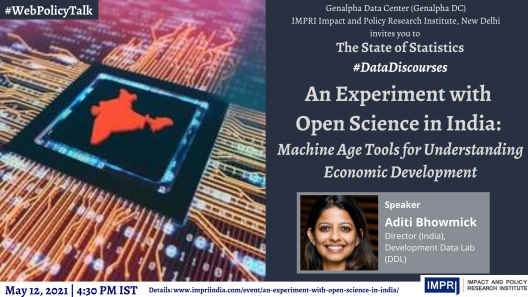
Aditi Bhowmick (Director (India), Development Data Lab (DDL)) on An Experiment with Open Science in India: Machine Age Tools for Understanding Economic Development
When: May 12, 2021 (Wednesday); 16:30 IST | REGISTER HERE
|
|
|
|
Water and Climate
| |

|
Ecologists, scientists, grass root workers, health experts, nature activists, UN bodies, and others are warning that there is an urgent need for (i) Understanding the relationship between ‘water and climate and climate and water (ii) the importance of nature for sustainable development, given the scenarios that are presenting themselves due to climate change (iii) Spreading literacy around the linkages of water and climate and (iv) Identifying, proposing solutions to explore sustainable development for all. Fortunately, we are better positioned in terms of knowledge and practice, both from research institutions and grassroots models. This knowledge needs to have greater outreach for wider deliberation and inclusion in policy and practice.
With the above in mind, IMPRI and Tarun Bharat Sangh are collaborating to organize a set of interactive web policy dialogues that bring together thought leaders and practitioners from across the world, across various streams/ sectors, to share their thoughts and work. The purpose of these dialogues is to expand outreach for making informed policy and practice decisions that heal, restore and rejuvenate both nature and humanity. The series will be moderated by Dr Indira Khurana, Senior Expert, Water Sector.
|
|
|
|
The State of Development Discourses - #CohesiveDevelopment
| |
|
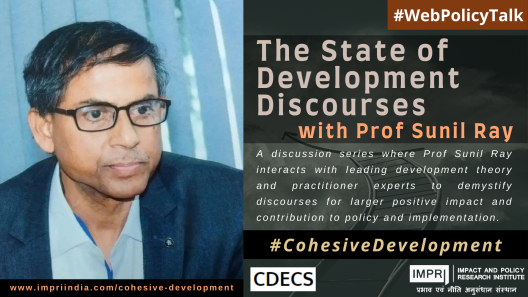
Creating and strengthening spaces for open, inclusive, and rigorous discourse must be emphasised, especially amid the unprecedented COVID-19 crisis, with the aim of moving towards informed and sensitive policymaking, planning, and impact.
With this background, IMPRI, New Delhi, along with Centre for Development Communication and Studies (CDECS), Jaipur, has launched a discussion series called The State of Development Discourses – #CohesiveDevelopment where Prof Sunil Ray, who has done pioneering work in this field, interacts with leading development theory and practitioner experts to demystify discourses for larger positive impact and contribution to policy and implementation.
|
|
|
|
| |
|
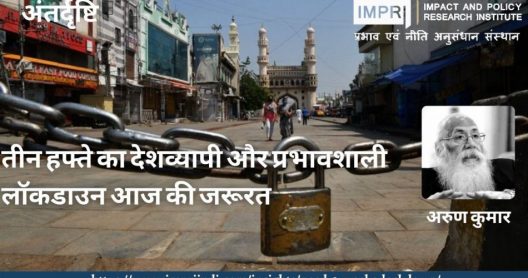
तीन हफ्ते का देशव्यापी और प्रभावशाली लॉकडाउन आज की जरूरत by Arun Kumar | #IMPRI insights
ऐसे में, लॉकडाउन ही एकमात्र विकल्प है। अगर तुरंत देशव्यापी तालेबंदी नहीं की गई, तो हालात और खराब हो सकते हैं। ब्राजील का उदाहरण हमारे सामने है। वहां लॉकडाउन को लेकर की गई हीला-हवाली से हालात इतने बिगड़ गए कि कोरोना संक्रमण और मौत के मामले में वह दूसरे स्थान पर पहुंच गया। अमेरिका में भी पिछले साल तत्कालीन राष्ट्रपति डोनाल्ड ट्रंप ने लॉकडाउन की अनदेखी की, जिसके कारण वहां संक्रमण काफी तेजी से फैला, जबकि उसके पास विश्व की सबसे बेहतरीन स्वास्थ्य सेवा है। स्पष्ट है, जिसने शुरू में ध्यान नहीं दिया, वहां हालात बिगडे़ और जहां संजीदगी दिखाई गई, वहां अब अर्थव्यवस्था खुलने लगी है। चीन इसका एक बड़ा उदाहरण है।
|
|
|
|
| |
|
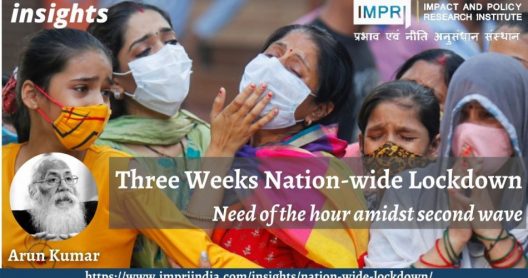
Three Weeks Nation-wide & Impactful Lockdown: Need of the Hour amidst Second Wave by Arun Kumar | #IMPRI insights
It has to be understood that till the hundred percent vaccination is done or all the people are infected and do not get immunity, then the pace of infection will continue to decrease. Right now, every infected person is making three to four people sick. Our ‘reproduction number’ will not remain below one until the transition remains high.
|
|
|
|
| |
|
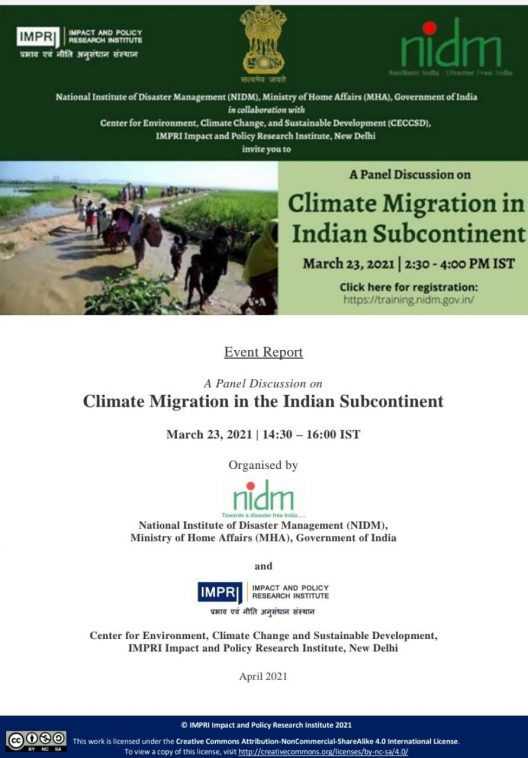
Event Report: A Panel Discussion on Climate Migration in the Indian Subcontinent by Amita Bhaduri, Anshula Mehta, Ritika Gupta, Sunidhi Agarwal, Ishika Chaudhary, Chhavi
Kapoor, Sajili Oberoi, Sakshi Sharda, and the IMPRI and NIDM Team | IMPRI
Climate Change is emerging as a stressor that is hindering the development of the Indian sub-continent as it is leading to the disruption in people’s lives to a large extent. This is clearly visible in increasing occurrences of floods, for
example, in Kerala, Assam and the Sundarbans region in the Indian subcontinent, and tsunamis in Sri Lanka, Bangladesh, and India. Global reports claim that there is a 21 percent decrease in global farming productivity due to
climate change, thus, it becomes very important to engage deeply into this issue
to build a constructive outlook. To deliberate upon this important and emerging global issue, the National Institute of Disaster Management, Ministry of Home Affairs, Government of India in collaboration with the IMPRI Centre for Environment, Climate Change, and Sustainable Development (CECCSD) organized a panel discussion on 23rd March 2021 on 'Climate Migration in the Indian Subcontinent'.
|
|
|
- 'Whither reforms? Pandemic 'witnessed' poor labour market governance in India' by Simi Mehta | Counterview
"Employment and work are the surest cures to both unemployment and poverty which are sure to haunt the people during Covid-19. However, Indian democracy is sturdier and its pluralistic approach is still dynamic and it is with hope I see distinct possibilities of “corrective actions” both inside the Parliament and Assemblies and outside. It is important that workers feel safe and that involves more than gestures and indirect actions like infusing liquidity in and providing no-collateral soft loans to firms, people and street vendors in the economy." - Prof K. R. Shyam Sundar at a #WebPolicyTalk
- 'The economic impact of the COVID-19 lockdown' by Arun Kumar | IMPRI
The issue is whether economic activity picked up to the pre-pandemic level in Q3 of 2020-21 as the official data indicates. As already argued, the official data is based largely on some indicators collected from the organised sector. Even the complete organised sector data is not available. For instance, data for companies is based on reports to the stock markets but only a few hundred company reports are available at any point of time and not all companies’ reports.
- 'National Education Policy: Looking Through the Lens of Repurposing Education Towards Thriving for Every Child' by Simi Mehta, Anshula Mehta | IMPRI
"A significant concern with regards to the education system is the prevalence of education inequality. Children who grow up in adverse conditions such as the lack of food and nutrition, abuse, neglect, and lack of emotional, their ability to achieve developmental milestones is affected. Thus, when they enter school, they do not possess the required cognitive faculties to access learning. This also manifests itself in the inability to demonstrate age-appropriate behaviour." - Vishal Talreja at a #WebPolicyTalk
- 'Will Educated Haryanvi Women benefit from the Haryana Reservation in Private Sector Bill?' by Simi Mehta, Anshula Mehta, Sunidhi Agarwal, Ishika Chaudhary | #IMPRI insights
The private sector needs to ensure that the conditions at work do not dehumanise women or place an additional stress on their lives. Apart from toilets, provisions of crèches and benefits such as maternity leave should not be seen as special favours. Women enter the paid workforce on unequal terms. A paid job is in addition to the unpaid “work” that they do every day – child care, elderly care, and domestic chores, among them.
- 'Biden Calls Another Summit : Threat of the Anthropocene' by Gurinder Kaur | The Citizen
|
|
|
| |
|
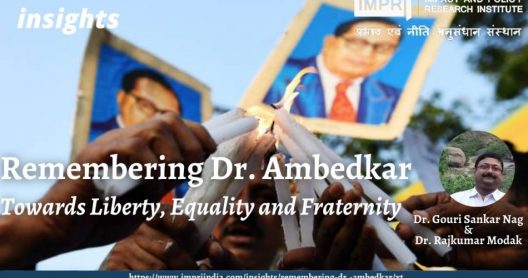
Remembering Dr. Ambedkar: Towards Liberty, Equality and Fraternity by Gouri Sankar Nag, Rajkumar Modak | #IMPRI insights
Dr. Ambedkar was truly an ‘Iconoclast’. It cannot be an acceptable proposition that at one point we should incorporate him as the Father of the Indian Constitution and thereafter at another moment of discord, we should discard him when we cannot reconcile with his sharply edged ideas. So, he needs to be studied not only as a messiah of the scheduled castes but also as an apostle of modern progressive India which he deprecated at the same time for inherent religious oppression.
|
|
|
- 'Climate-induced migration surges in the Indian sub-continent' by Author: Amita Bhaduri, Anshula Mehta, Ritika Gupta, Sunidhi Agarwal, Ishika Chaudhary, Chhavi Kapoor | India Water Portal
The climate change-migration nexus is real. It is necessary to focus on climatic drivers of migration. There is a need to analyse the social context of vulnerability as also the multiple interacting stressors, whose interlinkages need to be carefully analysed. Policies of exclusion should be negated and an appropriate institutional framework developed with a multi-layered approach to addressing inequalities. Universal social security can be a way forward. Resilient communities need to be built. Cities should come up with long term plans as the majority of the population will be inhabiting there by 2050.
- 'For migrants, hunger deadlier than COVID' by Basant Kumar Mohanty | The Telegraph
Labour economists have highlighted how the loss of work and the absence of government support are forcing migrants to leave their workplaces, especially in states where restrictions and curfews to contain the second wave of the pandemic have constrained economic activity.Small establishments have stopped operations and construction has been hamstrung in these states over the past two to three weeks. Railway stations and inter-state bus terminals in the major cities are crowded with home-bound migrants.
- Building a Planet-Friendly Economy by Simi Mehta, Amita Bhaduri | IMPRI
Dr R. Balasubramanium at a #WebPolicyTalk proposed a new economic model that is commonly known as the fourth sector economy. The fourth sector economy is very simple- it’s soulful, compassionate, and is driven by the principle of benefit optimization. Every participant in this economic food chain is a person who is contributing and therefore, deserves a benefit proportional to his contribution.This means that if one is going for work 8 hours a day, it’s not just the duration but also the intensity and non-replaceability of the contribution that decides the benefits one gets out of it. We all become stakeholder participants in the economy and not just shareholders that corporates have to worry about.
- 54% youth not job ready, yet NEP fails to recognise widening inequities in education by Simi Mehta, Anshula Mehta, Kashish Babbar | Counterview
Vishal Talreja, at a #WebPolicyTalk, elucidates how the innovative pedagogies presented in the NEP 2020 will transform the teacher learning process, i.e. how children learn. He further explains how teachers, through the use of such approaches and creating a conducive environment, will transform their role as primary sources of knowledge to the role of facilitators of learning. - 'Middle Ground in This Farmers’ Protest' by Arun Kumar | #IMPRI insights
Even though the movement is spearheaded by the farmers from Punjab – and supported in large numbers from Haryana and western Uttar Pradesh – it does not mean that the movement does not have support from farmers elsewhere. In movements, it is often the case that the better off sections lead since the poorer ones find it hard to take time off. The former is usually more organised and articulates the issues first and mobilise others.
- Impact of COVID-19, Reforms and Poor Governance on Labour Rights by Simi Mehta | Delhi Post
The lessons of the COVID-19 strongly call for the abdication of fiscal conservatism and frame a comprehensive and durable social assistance comprising direct benefit transfer, urban employment guarantee scheme and strengthening of MGNREGS.
|
|
|
| |
|
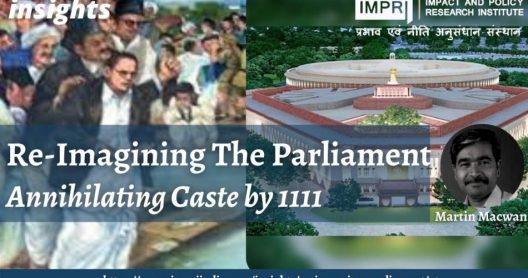
Re-Imagining The Parliament: Annihilating Caste by 1111 by Martin Macwan | #IMPRI insights While this may be considered as a legend, it is a historical fact that in many palatial homes, for their safety, the Dalits were buried in their foundation. This finds a mention in an essay published in ‘Gyanoday’ (1955) written by Mukta Salve who was one of the eight girls who attended the first-ever Dalit-girls-school in 1847 founded by Savitri and Jyotiba Phule. So, even today in the memory of Megh Mahya, every new house constructed is laid with a coin in the foundation, a symbol of a dream of peace and prosperity for all its dwellers. We need to lay a coin in the foundation of the upcoming Parliament house to ensure that it can truly build India as a democratic Nation, free of Untouchability. With the presence of Untouchability India can not become undivided Nation. We need to recognize the systemic violence and represent this recognition in the temple of Indian Democracy
|
|
|
- 'Uttarakhand Engulfed in Wildfires' by Gurinder Kaur | The Citizen
The people of Uttarakhand have been protesting against the government's forest policies and development plans since the 1950s. Although the 'Chipko Movement' for forest protection started here, which inspired all the countries of the world to protect forests, unfortunately the people of the state were unable to change the government policies to save Uttarakhand from natural calamities.
- 'फिर जिंदगी को तरजीह देने का वक्त' - अरुण कुमार | हिंदुस्तान
- 'Academic Autonomy: Needed a Holistic Societal Perspective' by Arun Kumar | Mainstream Weekly
The question arises why is society indifferent to the issue of academic autonomy? Higher education plays a crucial role in generation of socially relevant and cutting edge knowledge. But, if society does not value that then why would it prioritize higher education or the issue of academic autonomy which would appear to be esoteric subjects not worth engaging with.
- 'Re-Imagining Mental Health of Youth - Prof. Vikram Patel @ IMPRI #WebPolicyTalk' by Simi Mehta, Anshula Mehta | #IMPRI insights
"There is a need to look beyond narrowly defined and diagnosed mental illness offering a range of interventions with a focus on the “base of the pyramid” through task-sharing of psychosocial interventions. Secondly, it is important to balance individual clinical interventions with social and cultural determinants across the life course. Thirdly, it’s important to have digital tools for the workforce, health systems, and affected persons. Lastly, we need to ensure that youth is at the center of all decisions, from what matters to how it needs to be addressed."
- 'Response to the Mental Health woes of India’s Youth- Prof. Prabha Chandra@IMPRI #WebPolicyTalk' by Simi Mehta, Anshula Mehta | #IMPRI insights
"It is also important for health professionals to recognize and incorporate various methodologies to learn to build partnerships. As a professional group, mental health professionals are lagging behind in integrating and partnering with other groups to further the cause and normalize seeking help for mental health enough to be able to help those with problems, particularly the young people."
|
|
|
| |
|
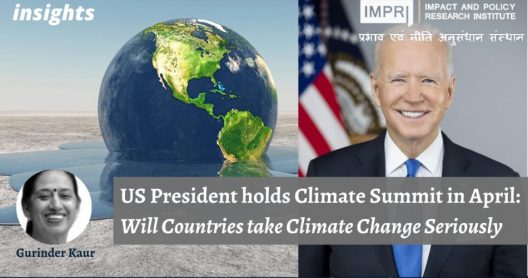
US President holds Climate Summit in April 2021: Will Countries Take Climate Change Seriously? by Gurinder Kaur | #IMPRI insights
Despite the warning given in a 2014 IPCC report and the facts stated at 2015 Paris Climate Conference regarding rising average temperature of the earth, many countries around the world still have not taken steps to reduce their carbon emissions. According to the Climate Watch data organisation, there are 80 countries in the world that have not yet made any changes in the framework for reducing carbon emissions according to the Paris Climate Agreement. These countries release 47.2 per cent of the world’s total carbon emissions into the atmosphere.
|
|
|
|
CDS Online Summer Workshop on Database on Indian Economy
Centre for Development Studies announces the introduction of a summer workshop on ‘Database on Indian economy’.
The lectures would introduce participants to databases on India pertaining to economic performance such as growth and development, financial indicators, infrastructure, institutions, regional and geographical information.
Dates: 7th June 2021 to 18th June 2021
Brochure | Application Form: PDF | MS Word
|
|
|
|
IV International Graduate Seminar on Quality of Living in Informal Settlements
TATA Institute of Social Sciences, Hyderabad IV International Graduate Seminar on Quality of Living in Informal Settlements
The Seminar will host 9 sessions in which 34 selected participants from India and abroad will be presenting their research papers. Date and time: April 19, 2021 2:00PM - April 21, 2021 5:30PM
Venue: Zoom
|
|
|
|
| |
|
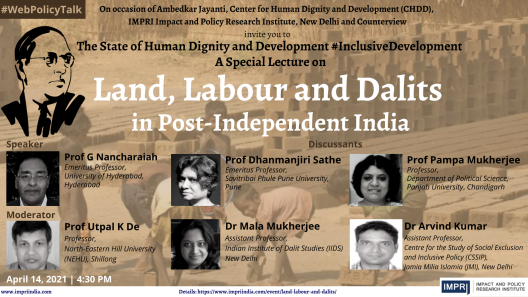
#InclusiveDevelopment: Prof G Nancharaiah
(Emeritus Professor, University of Hyderabad; Former Vice-Chancellor, Babasaheb Bhimrao Ambedkar Central University, Lucknow) on Land, Labour and Dalits in Post-Independent India
Moderated by Prof Utpal K De (North-Eastern Hill University (NEHU), Shillong), with discussants Prof Dhanmanjiri Sathe (Savitribai Phule Pune University, Pune), Dr Arvind Kumar (Jamia Millia Islamia (JMI), New Delhi), Prof Pampa Mukherjee (Panjab University, Chandigarh), Dr Mala Mukherjee (Indian Institute of Dalit Studies (IIDS), New Delhi)
|
|
|
|
| |
|
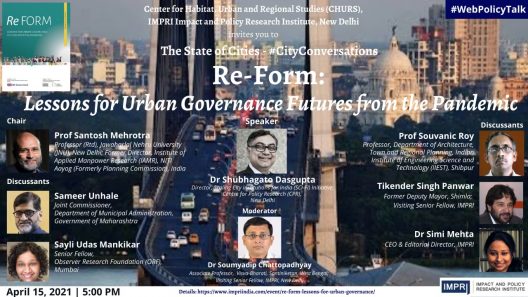
#CityConversations: Dr Shubhagato Dasgupta (Senior Fellow, Centre for Policy Research (CPR), New Delhi) on Re-Form: Lessons for Urban Governance Futures from the Pandemic
Discussants: Prof Santosh Mehrotra (Formerly, Jawaharlal Nehru University (JNU), New Delhi), Prof Souvanic Roy (Indian Institute of Engineering Science and Technology (IIEST), Howrah), Sayli Udas-Mankikar (Observer Research Foundation (ORF), Mumbai), Tikender Panwar (Former Deputy Mayor, Shimla), Sameer Unhale (Department of Municipal Administration, Government of Maharashtra)
|
|
|
|
| |
|
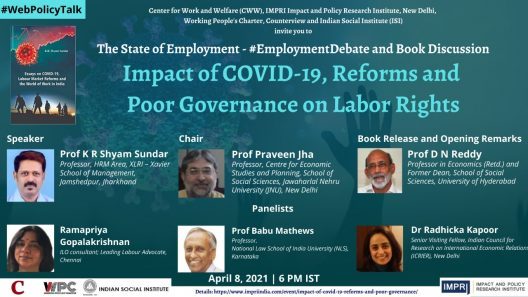
#EmploymentDebate and Book Discussion: Prof K. R. Shyam Sundar (Professor, HRM Area, XLRI – Xavier School of Management, Jamshedpur, Jharkhand) on Impact of COVID-19, Reforms and Poor Governance on Labor Rights
Chair: Prof Praveen Jha (Jawaharlal Nehru University, New Delhi)
Book Release and Opening Remarks: Prof D. N. Reddy (Formerly, University of Hyderabad)
Discussants: Ramapriya Gopalakrishnan (ILO Consultant and Labour Advocate, Chennai), Prof Babu Mathew (NLSIU, Bengaluru) and Dr Radhicka Kapoor (ICRIER, New Delhi)
|
|
|
| |
| |
Thank you for your continued encouragement and participation in our endeavours, and for your meaningful support towards our efforts in carrying out serious research. |
|
| |
|
|
| |
| |
IMPRI, a startup research think tank, is a platform for pro-active, independent, non-partisan and policy-based research. It contributes to debates and deliberations for action-based solutions to a host of strategic issues. IMPRI is committed to democracy, mobilization and community building. |
|
| |
|
|
|


