|
A weekly roundup of the latest at IMPRI! ͏ ͏ ͏ ͏ ͏ ͏ ͏ ͏ ͏ ͏ ͏ ͏ ͏ ͏ ͏ ͏ ͏ ͏ ͏ ͏ ͏ ͏ ͏ ͏ ͏ ͏ ͏ ͏ ͏ ͏ ͏ ͏ ͏ ͏ ͏ ͏ ͏ ͏ ͏ ͏ ͏ ͏ ͏ ͏ ͏ ͏ ͏ ͏ ͏ ͏ ͏ ͏ ͏ ͏ ͏ ͏ ͏ ͏ ͏ ͏ ͏ ͏ ͏ ͏ ͏ ͏ ͏ ͏ ͏ ͏ ͏ ͏ ͏ ͏ ͏ ͏ ͏ ͏ ͏ ͏ ͏ ͏ ͏ ͏ ͏ ͏ ͏ ͏ ͏ ͏ ͏ ͏ ͏ ͏ ͏ ͏ ͏ ͏ ͏ ͏ ͏ ͏ ͏ ͏ ͏ ͏ ͏ ͏ ͏ ͏ ͏ ͏ ͏ ͏ ͏ ͏ ͏ ͏ ͏ ͏ ͏ ͏ ͏ ͏ ͏ ͏ ͏ ͏ ͏ ͏ ͏ ͏ ͏ ͏ ͏ ͏ ͏ ͏ ͏ ͏ ͏ ͏ ͏ ͏ ͏ ͏ ͏ ͏ ͏ ͏ ͏ ͏ ͏ ͏ ͏ ͏ ͏ ͏ ͏ ͏
| |
| |
This Week at #IMPRI
(2021 | W13 | March 29 - April 4)
|
|
| |
|
|
Dear IMPRI Well-wisher,
Greetings from the team!
We hope for your continued wellbeing amid the imminent second wave of COVID-19, and hope that you continue to follow all safety precautions.
The newsletter provides an overview of this week's upcoming events , the week's publications, and videos of past week's #WebPolicyTalks in case you missed them. We hope to see you tune in to one of our events!
Wishing you a great week ahead,
Anshula Mehta, Assistant Director, IMPRI
|
|
|
Upcoming #WebPolicyTalks
Register to attend!
|
|
|
|
#EducationDialogue
| |

|
Vishal Talreja (Co-founder, Dream A Dream, Bangalore) on National Education Policy: Looking Through the Lens of Repurposing Education Towards Thriving for Every Child
When: April 6, 2021 (Tuesday); 16:30 IST | REGISTER HERE
|
|
|
|
#CityConversations
| |
|
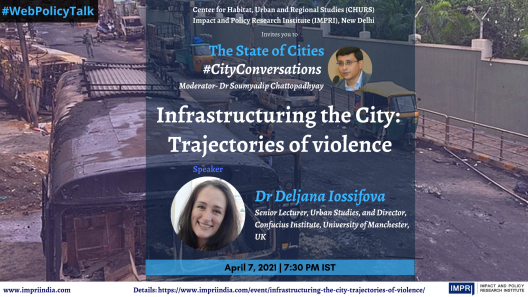
Dr Deljana Iossifova (Senior Lecturer, Urban Studies, University of Manchester; Director, Confucius Institute, UK) on Infrastructuring the City: Trajectories of Violence
When: April 7, 2021 (Wednesday); 19:30 IST | REGISTER HERE
|
|
|
|
#EmploymentDebate and Book Discussion
| |

|
Dr K. R. Shyam Sundar (Professor, HRM Area, XLRI – Xavier School of Management, Jamshedpur, Jharkhand) on Impact of COVID-19, Reforms and Poor Governance on Labor Rights
When: April 8, 2021 (Thursday); 18:00 IST | REGISTER HERE
|
|
|
|
#CityConversations
| |

|
Dr Shubhagato Dasgupta (Senior Fellow, Centre for Policy Research (CPR), New Delhi) on Re-Form: Lessons for Urban Governance Futures from the Pandemic
When: April 15, 2021 (Thursday); 17:00 IST | REGISTER HERE
|
|
|
|
#TowardsAccountability
| |

|
Dr Munawer Khwaja (Fiscal Economist, Former Technical Advisor, Fiscal Affairs Department, International Monetary Fund) on Are We in Good Hands? Is Tax Administration in India Following Good International Practices?
When: April 22, 2021 (Thursday); 18:00 IST | REGISTER HERE
|
|
|
|
Call for Applications: CrossCulture Programme Fellowships and Synergy Funding
Institut für Auslandsbeziehungen (ifa/Institut for Foreign Cultural Affairs) is happy to inform you that its 2 calls for applications of the CrossCulture Fellowship Programme 2021 as well as CCP Synergy Programme for 5 countries of the Indo-Pacific region are launched!
Through its CCP Fellowships, every year the CCP supports around 120 young professionals and volunteers from over 45 countries. By working in host organisations in Germany and other CCP countries, participants have an opportunity to deepen their professional knowledge and acquire intercultural skills Due to the Covid-19 pandemic and ongoing travel restrictions, ifa is currently offering remote fellowships only. CrossCulture Programme will be offered as a part-time fellowship for the period from June until November 2021.
CrossCulture Programme: Webpage | Apply
CCP Synergy programme supports civil society organisations from Germany and from i.a. India, Nepal, Myanmar, Bhutan and Sri Lanka to work together on a joint initiative and create lasting networks. Due to ongoing Covid-19 travel restrictions, all collaborations can be planned as remote ventures. CCP Synergy: Webpage
Application Deadline: 12 April 2021
|
|
|
- 'What Changed and What Didn't in One Year of a Pandemic and Lockdown' by Arun Kumar | The Wire
The world is headed towards a new normal with increasing automation, digitisation, e-commerce, etc. Travel, tourism, entertainment, education, remote working, etc. have undergone big changes. Unemployment will rise due to increasing automation. Workers need to be paid a living wage so that they can face the challenge of a future pandemic.
- 'The Mental Health of India’s Youth' by Simi Mehta and Anshula Mehta | IMPRI
"Promoting youth’s mental health is everyone’s business. Mental health is affected not because of biology but the world that we live in. Some challenges that prevent the youth from addressing their mental health issues include narrow binary biomedical framing of mental health, lack of tailoring to the needs of the disadvantaged youth, lack of attention to mental health programs to social determinants, lack of skilled providers, and reluctance to seek help from professionals. Thus, it is imperative to reimagine youth mental health." : Prof Vikram Patel at a #WebPolicyTalk
- 'The Unnecessary Jargon of Ease of Living Index' by Tikender Singh Panwar | IMPRI
But all said and done, for what is all this data being collected, is it for catching the imagination and aspirations of the people in the cities or for some large corporates who are eyeing cities as an investment avenue? Instead, one simple thing that the ministry must do is to empower the city governments and the people by devising ways and mechanisms where the ownership of the city is reclaimed by them and they do not feel alienated.
- 'PM Modi’s Bangladesh Visit to strengthen the two countries relationship' by Ayush Majumdar and Gouri Sankar Nag | IMPRI
There has not been the generation of the same level of bonhomie that India enjoys or maintains with Bhutan or Maldives within the South Asian region despite the fact that India played such an imperative role in the transition to Bangladesh from the East Pakistan which was in a subservient position vis-à-vis West Pakistan in the metropolis-periphery relationship. However, the post-liberation experience in the Indo-Bangladesh relationship was marked by slumber in contrast to the enthusiasm that was expected out of it.
- 'India: Union Budget 2021-22 And The Roadmap Towards Building Inclusive Cities – Analysis' by Soumyadip Chattopadhyay and Arjun Kumar | Eurasia Review
To comprehensively respond towards demands for social welfare and urban development, the gaping structural and management concerns have to be catered to. India could learn from the international best practices, keeping variables like population and resources into consideration.
- 'Urban lake governance and sustainability' by Simi Mehta and Amita Bhaduri | India Water Portal
At a #WebPolicyTalk, Mansee Bal Bhargava emphasized the broader concept of conserving water reflecting on the importance of pricing it, citing the unsustainable use of it by the county's middle class. The need to manage and have better wastewater treatment facilities also serves its purpose as an example of water regeneration. Finally, groundwater which she believes is the prime component of the water cycle (that includes the process of percolation of water in a lake slowly under the ground) is where the focus should be.
- 'Gender-based Violence & Safety: Orchestrating the Role of Men, Women, Communities, and Spaces' by Simi Mehta and Anshula Mehta | IMPRI
"Violence is not only physical and social, it can result in any form of marginalisation. Any form of denial of opportunity or access to space in itself is violence. Women are discriminated against from the time of their birth till their death, they are constantly competing for scarce resources where they control neither ownership of capital or property": Priya Varadarajan at a #WebPolicyTalk
- 'Lessons from the Uttarakhand disaster' by Simi Mehta, Amita Bhaduri | India Water Portal
The government instead of exercising caution about developing hydropower has gone ahead with projects on the plea of building defence capacities or for promoting the tourism sector. These reasons are never-ending, but a cost-benefit analysis will be useful to assess the economic and social impact of the disasters and economic returns from tourism. Further, naming these disasters as ‘natural disasters’ and not man-made is nothing but greed that mankind hasn’t been able to contain. - 'Need to contribute to Earth Hour campaign to save environment from Light Pollution' by Gurinder Kaur | Counterview
Guided by the Earth Hour campaign, some big cities have started turning off non-essential lights every day in main areas of the city. The city of Mount Rushmore in South Dakota, USA is making every effort to turn off the lights every night from 9 to 11 pm. New Island, an island nation in the Pacific Ocean, has become the world’s first ‘Dark Sky Place’, with no lights on at night.
- 'The Law in my Kitchen: Questions about Gender, Agency, and the State' by Simi Mehta and Anshula Mehta | IMPRI
The relationship between law and desire is another question that demands discourse. If they have been relegated to different spheres of life i.e, the public for the law and private for desire, then it’s important to look at the interaction between the two. Dr Madhavi Menon, at a #WebPolicyTalk, posed the question, “Is the relationship between the two only and always antagonistic, which is to say is law always trying to control desire? Or is the law also enabling when it comes to questions of gender, sexuality and desire?”
- 'New pregnancy law: Should women justify abortion? Whither reproductive rights?' by Simi Mehta and Nishi Verma | Counterview
The passage of a law legalizing abortion is necessary, but not a sufficient condition for ensuring access to safe and effective abortion services. It is equally important to ensure that women are apprised of their legal rights, service provision of women and health-related barriers to accessing services are addressed adequately. The best way to stop abortion is to prevent unwanted pregnancies.
- 'Using Technology to Address Gender-based Violence' by Simi Mehta and Anshula Mehta | IMPRI
"It’s important to understand that sexual violence and abuse is a spectrum as it involves non-verbal, verbal and physical actions which affect women’s choices, movements and mental health.‘Safe city’ encourages anonymous reporting of people’s personal experiences which is then geo-tagged on the maps. The aim is to make public spaces safe and equally accessible to all through Individual awareness, community engagement and institutional accountability.": Elsa Marie D'Silva at a #WebPolicyTalk
|
|
|
| |

|
Panel Discussion: Climate Migration in the Indian Subcontinent
Organised by National Institute of Disaster Management, Ministry of Home Affairs in collaboration with Center for Environment, Climate Change, and Sustainable Development (CECCSD), IMPRI
Patron: Maj Gen Manoj K Bindal (Executive Director, NIDM, New Delhi)
Convenor: Prof Anil K Gupta (Head, ECDRM, NIDM, New Delhi)
Moderator and Host: Dr Simi Mehta (CEO, IMPRI)
Panelists: Prof R B Bhagat (International Institute for Population Sciences (IIPS), Mumbai), Prof Rekha Nianthi (University of Peradeniya, Sri Lanka), Prof Mizan R Khan (Independent University, Bangladesh), Mr Karan Mangotra (UN Environment Programme (UNEP), India Office), Dr Fawzia Tarannum (TERI School of Advanced Studies, New Delhi), Prof Deepak K Mishra (Jawaharlal Nehru University (JNU), New Delhi)
|
|
|
|
| |
|
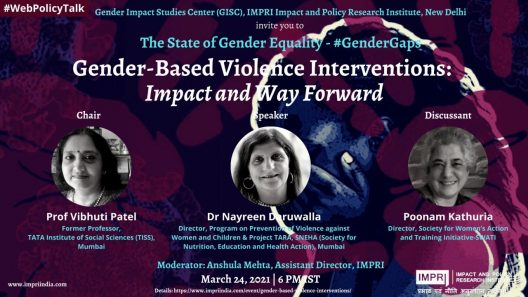
#GenderGaps: Dr Nayreen Daruwalla (Director, Program on Prevention of Violence against Women and Children & Project TARA, SNEHA (Society for Nutrition, Education and Health Action)) on Gender-based Violence Interventions: Impact and Way Forward
Chaired by Prof Vibhuti Patel (Formerly, TISS, Mumbai), with discussant Poonam Kathuria (SWATI)
|
|
|
|
| |
|
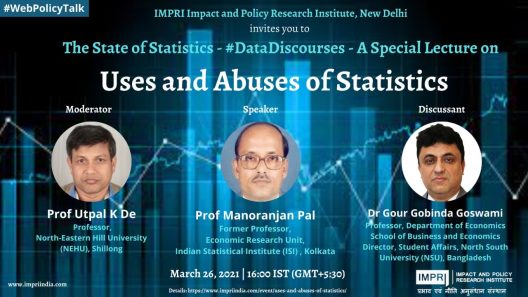
Special Lecture: Prof Manoranjan Pal (Former Professor, Economic Research Unit, Indian Statistical Institute (ISI), Kolkata) on Uses and Abuses of Statistics
Moderated by Prof Utpal K De (North-Eastern Hill University, Shillong), with discussant Prof Gour Gobinda Goswami (North South University, Bangladesh)
|
|
|
| |
| |
Thank you for your continued encouragement and participation in our endeavours, and for your meaningful support towards our efforts in carrying out serious research. |
|
| |
|
|
| |
| |
IMPRI, a startup research think tank, is a platform for pro-active, independent, non-partisan and policy-based research. It contributes to debates and deliberations for action-based solutions to a host of strategic issues. IMPRI is committed to democracy, mobilization and community building. |
|
| |
|
|
|


