|
A weekly roundup of the latest at IMPRI! ͏ ͏ ͏ ͏ ͏ ͏ ͏ ͏ ͏ ͏ ͏ ͏ ͏ ͏ ͏ ͏ ͏ ͏ ͏ ͏ ͏ ͏ ͏ ͏ ͏ ͏ ͏ ͏ ͏ ͏ ͏ ͏ ͏ ͏ ͏ ͏ ͏ ͏ ͏ ͏ ͏ ͏ ͏ ͏ ͏ ͏ ͏ ͏ ͏ ͏ ͏ ͏ ͏ ͏ ͏ ͏ ͏ ͏ ͏ ͏ ͏ ͏ ͏ ͏ ͏ ͏ ͏ ͏ ͏ ͏ ͏ ͏ ͏ ͏ ͏ ͏ ͏ ͏ ͏ ͏ ͏ ͏ ͏ ͏ ͏ ͏ ͏ ͏ ͏ ͏ ͏ ͏ ͏ ͏ ͏ ͏ ͏ ͏ ͏ ͏ ͏ ͏ ͏ ͏ ͏ ͏ ͏ ͏ ͏ ͏ ͏ ͏ ͏ ͏ ͏ ͏ ͏ ͏ ͏ ͏ ͏ ͏ ͏ ͏ ͏ ͏ ͏ ͏ ͏ ͏ ͏ ͏ ͏ ͏ ͏ ͏ ͏ ͏ ͏ ͏ ͏ ͏ ͏ ͏ ͏ ͏ ͏ ͏ ͏ ͏ ͏ ͏ ͏ ͏ ͏ ͏ ͏ ͏ ͏ ͏
| |
| |
This Week at #IMPRI
(2021 | W9 | March 1 - 7)
|
|
| |
|
|

|
Dear IMPRI Well-wisher,
Greetings from the team!
With the second phase of the COVID-19 vaccine set to roll out from March 1, and COVID-19 guidelines extended till March 31 in view of the recent surge in cases, adhering to safety precautions remains as important as it was a year ago, as we move forward in combating the Coronavirus crisis.
We delved into insightful discussions at our #WebPolicyTalks this past week on gender-based violence and safety, education and employability, and global protest politics, with diverse sets of enriching perspectives from all our panelists.
We continue this week, exploring how the status quo in Indian cities can be broken, how technology can be used in addressing gender-based violence, and questions on gender, agency and the State in an exciting talk - 'The Law in My Kitchen'.
The newsletter provides an overview of these upcoming events , the week's publications, and videos of past week's #WebPolicyTalks in case you missed them. We hope to see you tune in to one of our events!
Hope you have a great week ahead,
Anshula Mehta, Assistant Director, IMPRI
|
|
|
Upcoming #WebPolicyTalks
Register to attend!
|
|
|
|
#CityConversations
| |

|
Srikanth Viswanathan (Chief Executive Officer, Janaagraha Centre for Citizenship and Democracy) and Srinivas Alavilli (Lead, IChangeMyCity, The Civic Tech Platform of Janaagraha; Co-Founder, #SteelFlyoverBeda Movement) on The Status Quo in India’s Cities: How to break it?
When: March 1, 2021; 18:00 IST (Monday) | REGISTER HERE
Chaired by Prof Tathagata Chatterji (Xavier Institute of Management, Bhubaneswar) and moderated by Dr Soumyadip Chattopadhyay (Visva-Bharati; IMPRI), with discussants Dr Lalitha Kamath (TISS, Mumbai), Shubhagato Dasgupta (Centre for Policy Research, New Delhi), Tikender Singh Panwar (Former Deputy Mayor, Shimla)
|
|
|
|
#GenderGaps
| |

|
Elsa Marie D'Silva (Founder, Red Dot Foundation) on Using Technology to Address Gender-based Violence
When: March 3, 2021; 18:00 IST (Wednesday) | REGISTER HERE
|
|
|
|
Special Lecture
| |
|
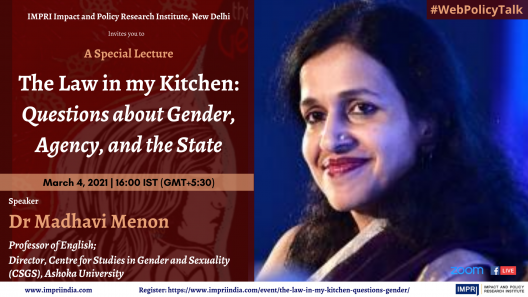
Dr Madhavi Menon (Professor of English; Director, Center for Studies in Gender and Sexuality, Ashoka University) delivers a talk - The Law in My Kitchen: Questions on Gender, Agency, and the State
When: March 4, 2021; 16:00 IST (Thursday) | REGISTER HERE
|
|
|
|
#CityConversations
| |

|
Prof P. S. N. Rao (Director, School of Planning and Architecture (SPA), New Delhi) on The State of Real Estate and Housing in India amidst the COVID-19 Pandemic: Impact and the Way Forward
When: March 13, 2021; 11:00 IST (Saturday) | REGISTER HERE
|
|
|
|
| |
|
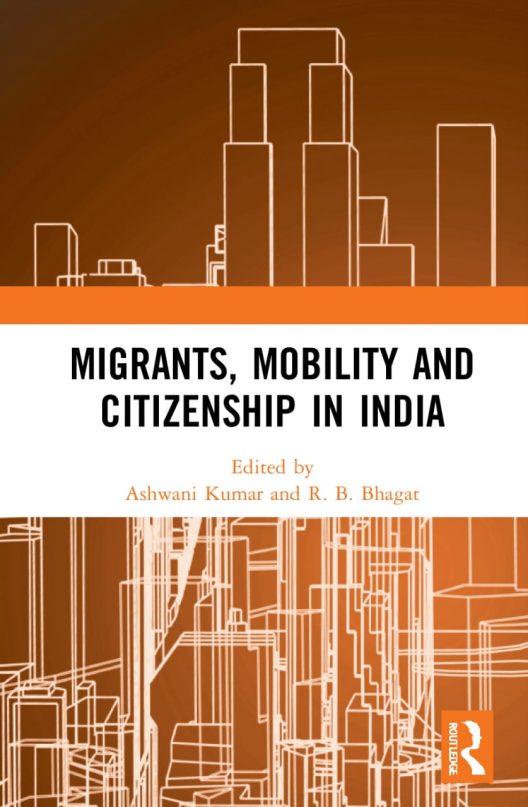
Migrants, Mobility and Citizenship in India | Routledge India | 2021
Edited By Ashwani Kumar and R. B. Bhagat
This book reconceptualizes migration studies in India and brings back the idea of citizenship to the center of the contested relationship between the state and internal migrants in the country. It interrogates the multiple vulnerabilities of disenfranchised internal migrants as evidenced in the mass exodus of migrants during the COVID-19 crisis. Challenging dominant economic and demographic theories of mobility and relying on a wide range of innovative heterodox methodologies, this volume points to the possibility of re-imagining migrants as ‘citizens’.
|
|
|
- 'Water: Governance challenges and suggested tools' by Simi Mehta and Amita Bhaduri | India Water Portal
“The case of Dahanu is emblematic of the challenges faced in the country’s water governance. Similar cases abound everywhere be it in Narmada valley, Statue of Unity, Ken Betwa river-linking proposal etc,” said Himanshu Thakkar, coordinator of South Asia Network on Dams, Rivers & People speaking at a #WebPolicyTalk
- 'Climate Emergency, Disasters and Resilience-Inclusive Business Continuity Management' by Simi Mehta and Amita Bhaduri | IMPRI India
Addressing the delayed focus on understanding risk, Dr Anil K Gupta at a #WebPolicyTalk explained that disaster risk is dynamic and it has become complex with climate change - "Our very knowledge of disasters has evolved over the years. There is a shift of focus from hazards that can be natural to anthropogenic vulnerabilities....vulnerabilities do not fall from the sky” - emphasizing that hazards like rainfall can be natural, but poor drainage design is attributable to humans. - 'Challenges And Ways Forward Towards Freedom From Child Sexual Abuse' by Simi Mehta, Anshula Mehta and Nishi Verma | Youth Ki Awaaz
"A kind of model is needed with a preventative lens that encourages deterrence efforts and intervention and treatment as it ensures the safety of an entire population. It should have the potential to diminish the number of sexual offenders in the general population and diminish the sexual victimisation in the community. It should work with the objectives of risk reduction, primary, secondary and tertiary-level prevention." - Pooja Taparia at a #WebPolicyTalk
- 'India needs accountability, should clean up politics, end cronyism: Dr Arun Kumar' by Soumyadip Chattopadhyay and Arjun Kumar | Counterview
Dr Arun Kumar went on to add that the rapid spree of disinvestments that are in the pipeline will flood the asset markets, leading to a drop in the asset prices. This will provide the crony capitalists with cheap assets. Further, commenting on the increased investments in capital intensive projects, he added that in the allocation of said projects, the crony capitalists may interfere and impair transparent and unbiased allocation. This can lead to the formation of large monopolies in several sectors like telecom.
- 'India needs to create a holistic mitigation plan to achieve 2030 climate targets' by Simi Mehta, Ritika Gupta and Manoswini Sarkar | Counterview
Any complacency cannot be afforded. A decrease in the Ministry of Environment, Forests and Climate Change’s budget allocation, from ₹3100 crore in 2020-21 to ₹2869 crore is not an encouraging signal. This is especially true for the renewable energy sector where India needs to step up its planning and implementation as we move towards attaining the Agenda 2030 goals. - 'Trifling recommendations by XV Finance Commission for Cities' by Tikender Singh Panwar | IMPRI India
The notion of cities being the engines of growth continues to plague the FC-XV. Since the UN-Habitat III there has been a concerted effort to focus on sustainability goals and not treat cities as market entrepreneurs. Unsustainable cities have been complemented with humongous inequity. The measures should reduce such inequality. Unfortunately, the recommendations continue with the same jargon and intent.
- 'The State Of Education Amidst The COVID-19 Pandemic' by Madhav Chavan | Youth Ki Awaaz
As we look forward, we need to recognize that learning anything, anytime and anywhere is not only possible but necessary. Institutions of learning have created several barriers including overambitious curricula, stringent admission criteria for higher educational institutes, and centralized certifying authority. These barriers have to go. We need to allow learning processes to develop freely and certification should facilitate free learning.
- 'Decentralized Water Resources Management: Role of Village Communities and Rural Local Governments' by Simi Mehta and Amita Bhaduri | IMPRI India
Liby Johnson, at a #WebPolicyTalk, recommends adopting different parameters for distinction. Rather than categorizing as rural and urban, he stated that differences should be made based on the prevalence of local resources of water. Decentralized and distributed water systems from local resources of water are cost-effective and thus help in reducing costs while simplifying the rural-urban divide. - 'Climate Change Interventions, COP 26, Budget 2021 and India NDC' by Simi Mehta, Ritika Gupta and Manoswini Sarkar | IndraStra Global
With regards to the NDC about creating an additional carbon sink, not much is being done in the afforestation/reforestation sector. There is a lack of data pertaining to the Green India Mission and reports show that the Mission has been consistently missing its targets due to a lack of funding at the centre and state level. There needs to be a dedicated ministry or committee responsible for afforestation, which should be funded adequately and take the recommendations of an expert panel on mapping and planning. - 'Flood: An Engineer’s Disaster Or A Historian’s Natural Process?' by Simi Mehta and Amita Bhaduri | Youth Ki Awaaz
"Historians view floods as a natural fluvial process and look towards flood unitization the way it had been done historically, like tapping riverine silt and mud for cultivation and exploiting fish habitats. The Historians call for the development of strategies for adaptation and not models of predication to control and manage floods like the engineers aim to do." - Dr Rohan D'Souza at a #WebPolicyTalk
- 'Government needs to be an active participant in disaster research' by Amita Singh | The Daily Guardian
It is high time that the government looks at the norms of openness and research, rather than dubbing it as suspicious activity in preparation of overthrowing the government...Disaster management needs openness and, more than anything else, to be liberated from the fortress of the NDMA and hold the hands of communities and researchers. - 'Urban Affairs of Budget 2021' by Tathagata Chatterji | IndraStra Global
The Budget had reposed faith in the supply-side approach, focusing on augmenting urban infrastructure and had sought to favor the PPP model to deliver significant projects. Except for metro rail projects, direct budgetary support for urban sector schemes does not show any appreciable increase. This could be attributed to the difficulties faced by the government due to COVID-induced economic downturn and shortfalls in revenue collection.
- 'उत्तराखंड बाढ़ आपदा 2.0: विश्लेषण से कार्रवाई तक' | अमिता भादुड़ी, ऋतिका गुप्ता
सभी हितधारकों से प्रतिक्रिया प्राप्त करने की आवश्यकता है। छात्रों और समुदाय को निर्दिष्ट प्राधिकारी के साथ स्थानीय मौसम पर नज़र रखने की आवश्यकता है। स्थानीय लोगों द्वारा राज्य में और इस क्षेत्र में काम करने वाले ग्लेशियोलॉजिस्टों को प्रशिक्षित करें जो उनके आसपास के क्षेत्र की खोज करने में विशेषज्ञ हैं ।सूचना का रियल टाइम मॉनिटरिंग और टिप्पणियों का घनत्व अधिक होना चाहिए। सेंसर-आधारित सतर्कता प्रणाली जैसी नई और समान रूप से महत्वपूर्ण प्रौद्योगिकियों के लिए तत्पर रहने की आवश्यकता है जो संबंधित एजेंसियों को जानकारी देगी और जो तब और जब आवश्यक हो, जनता को पर्याप्त और आवश्यक जानकारी पारित करेगी।
- 'Feminist Media As An Alternative Mainstream Media' by Simi Mehta, Anshula Mehta and Nishi Verma | Youth Ki Awaaz
"‘Spooky’ headlines are made to invoke horror and shock among people, which are generally insensitive and problematic. The featured images are often insensitive depicting the victim’s helplessness and misery throughout her life. The language used, highly blames victims by putting them in bad light ignoring the perpetrator completely. This whole wrong use of speeches influences the thinking of the public. Thus, it is important to shift the media focus from victim to perpetrators." - Japleen Pasricha at a #WebPolicyTalk
- 'IMPRI survey: 72% Bihar casual workers reported they were jobless during pandemic' | Counterview
As we seek to rebuild from the twin health and economic crises brought about by this pandemic, it is incredibly critical to ensure the active involvement of VillageMakers in decision-making within their families and households and the planning and implementation of programs that aim to impact their lives positively. They are among the hardest hit by this pandemic, but they will also be the backbone of rebuilding efforts if their involvement and leadership are leveraged for economic recovery.
- 'ग्रामीण बिहार में कोविड-19 महामारी द्वारा बढ़ाई गई महिला विलेजमेकर्स की परेशानियाँ: सर्वे फाइंडिंग्स' | प्रभाव एवं नीति अनुसंधान संस्थान और सेंटर फॉर कैटेल्यिंग चेंज
प्रभाव एवं नीति अनुसंधान संस्थान ने सेंटर फॉर कैटेल्यिंग चेंजेज के सकश्मा पहल के सहयोग से, बिहार राज्य के ग्रामीण क्षेत्रों में एक टेलीफोनिक समय-उपयोग सर्वेक्षण किया। सर्वेक्षण सितंबर और अक्टूबर 2020 के दौरान आयोजित किया गया था और सभी 38 जिलों को कवर किया गया था | ग्रामीण बिहार में 1039 विलेजमेकर्स का साक्षात्कार किया । कोविड-19 लॉकडाउन के दौरान घरेलू हिंसा, बाल विवाह, और महिलाओं के लिए अवैतनिक कार्य और आजीविका में नुकसान को बढ़ा दिया गया था।
- 'How Financially Feasible Would it be to Extend the MSP to All Crops?' by Arun Kumar | The Wire
Announcing MSP for all of agricultural produce would lead to development from below and is doable within the present resources. The challenge would be administrative and inflationary pressures but fairness demands that the living standard of others should not be at the expense of the farmers’ incomes.
|
|
|
| |
|
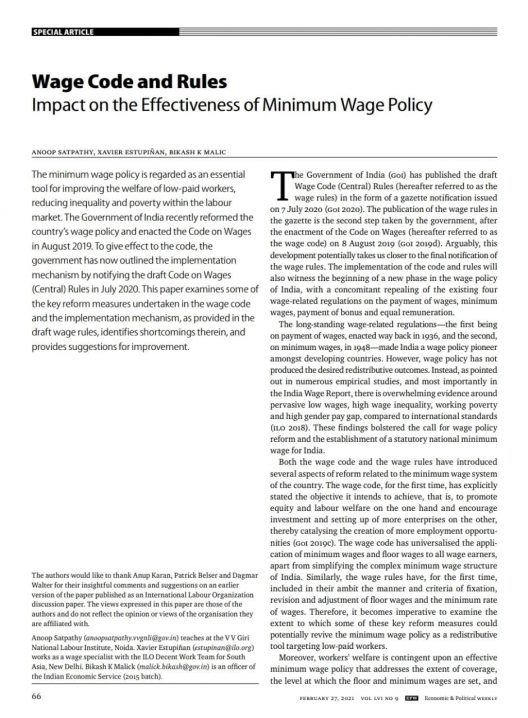
Wage Code and Rules: Impact on the Effectiveness of Minimum Wage Policy by Anoop Satpathy, Xavier Estupiñan and
Bikash K. Malick | Economic and Political Weekly
The minimum wage policy is regarded as an essential tool for improving the welfare of low-paid workers, reducing inequality and poverty within the labour market. The Government of India recently reformed the country’s wage policy and enacted the Code on Wages in August 2019. To give effect to the code, the government has now outlined the implementation mechanism by notifying the draft Code on Wages (Central) Rules in July 2020. This paper examines some of the key reform measures undertaken in the wage code and the implementation mechanism, as provided in the draft wage rules, identifies shortcomings therein, and provides suggestions for improvement.
|
|
|
|
| |
|
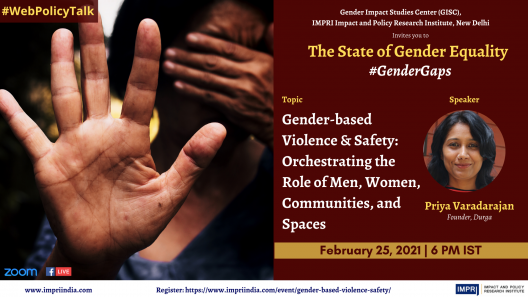
#GenderGaps: Priya Varadarajan (Founder, Durga) on Gender-based Violence & Safety: Orchestrating the Role of Men, Women, Communities, and Spaces
Chaired by Prof Vibhuti Patel (Formerly, TISS, Mumbai) with discussant Dr Tanvir Aeijaz (University of Delhi)
|
|
|
|
| |

|
Panel Discussion: Learning by Comparing Global Protest Politics: BLM, Anti-CAA, Farm Protest
Chaired and moderated by Prof Ajay Gudavarthy (Jawaharlal Nehru University, New Delhi), the panel brought together Prof Hilal Ahmed (Centre for the Study of Developing Societies (CSDS), New Delhi) and Prof Jeffrey C. Alexander (Yale University, USA), with Prof Harbans Mukhia (Formerly, Jawaharlal Nehru University) and Dr Trevor Stack (University of Aberdeen)
|
|
|
|
| |
|
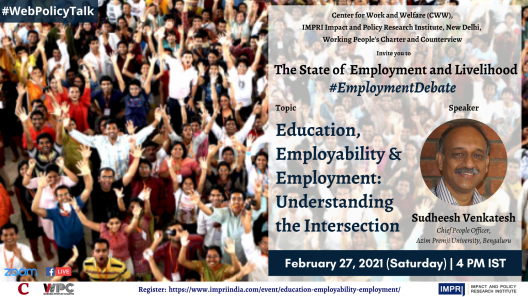
#EmploymentDebate: Sudheesh Venkatesh (Chief People Officer, Azim Premji University, Bengaluru) on Education, Employability & Employment: Understanding the Intersection
Chaired by Prof Sachidanand Sinha (Jawaharlal Nehru University, New Delhi) and moderated by Dr Simi Mehta (IMPRI)
|
|
|
| |
| |
Thank you for your continued encouragement and participation in our endeavours, and for your meaningful support towards our efforts in carrying out serious research. |
|
| |
|
|
| |
| |
IMPRI, a startup research think tank, is a platform for pro-active, independent, non-partisan and policy-based research. It contributes to debates and deliberations for action-based solutions to a host of strategic issues. IMPRI is committed to democracy, mobilization and community building. |
|
| |
|
|
|


