|
A weekly roundup of the latest at IMPRI! ͏ ͏ ͏ ͏ ͏ ͏ ͏ ͏ ͏ ͏ ͏ ͏ ͏ ͏ ͏ ͏ ͏ ͏ ͏ ͏ ͏ ͏ ͏ ͏ ͏ ͏ ͏ ͏ ͏ ͏ ͏ ͏ ͏ ͏ ͏ ͏ ͏ ͏ ͏ ͏ ͏ ͏ ͏ ͏ ͏ ͏ ͏ ͏ ͏ ͏ ͏ ͏ ͏ ͏ ͏ ͏ ͏ ͏ ͏ ͏ ͏ ͏ ͏ ͏ ͏ ͏ ͏ ͏ ͏ ͏ ͏ ͏ ͏ ͏ ͏ ͏ ͏ ͏ ͏ ͏ ͏ ͏ ͏ ͏ ͏ ͏ ͏ ͏ ͏ ͏ ͏ ͏ ͏ ͏ ͏ ͏ ͏ ͏ ͏ ͏ ͏ ͏ ͏ ͏ ͏ ͏ ͏ ͏ ͏ ͏ ͏ ͏ ͏ ͏ ͏ ͏ ͏ ͏ ͏ ͏ ͏ ͏ ͏ ͏ ͏ ͏ ͏ ͏ ͏ ͏ ͏ ͏ ͏ ͏ ͏ ͏ ͏ ͏ ͏ ͏ ͏ ͏ ͏ ͏ ͏ ͏ ͏ ͏ ͏ ͏ ͏ ͏ ͏ ͏ ͏ ͏ ͏ ͏ ͏ ͏
| |
| |
This Week at #IMPRI
(2021 | W8 | February 22 - 28)
|
|
| |
|
|
Dear IMPRI Well-wisher,
Greetings! We hope you are well and safe.
The last week at IMPRI saw discussions ranging from lived experiences of suicide bereavement and its gendered dimensions, to an analysis of the Chamoli catastrophe, and ascertaining an actionable way forward.
Upcoming events include sessions on gender-based violence and safety, education and employability, breaking the status quo of Indian cities, and a topical deliberation on learning from global protest politics.
The newsletter provides an overview of the upcoming #WebPolicyTalks, the week's publications, and videos of past week's #WebPolicyTalks in case you missed them.
Wishing you the best for the coming week,
Anshula Mehta, Assistant Director, IMPRI
|
|
|
Upcoming #WebPolicyTalks
Register to attend!
|
|
|
|
#GenderGaps
| |
|
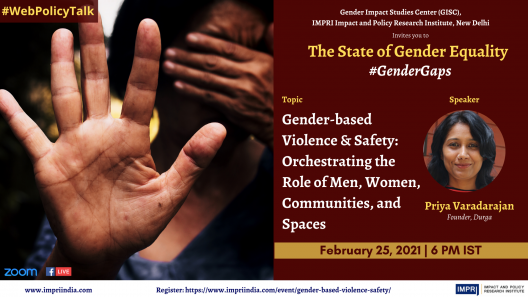
Priya Varadarajan (Founder, Durga) on Gender-based Violence & Safety: Orchestrating the Role of Men, Women, Communities, and Spaces
When: February 25, 2021; 18:00 IST (Thursday) | REGISTER HERE
|
|
|
|
Panel Discussion
| |

|
Panel Discussion on Learning by Comparing Global Protest Politics: BLM, Anti-CAA, Farm Protest
When: February 26, 2021; 19:00 IST (Friday) | REGISTER HERE
Chaired and moderated by Prof Ajay Gudavarthy (Jawaharlal Nehru University, New Delhi), the panel brings together Prof Hilal Ahmed (Centre for the Study of Developing Societies (CSDS), New Delhi) and Prof Jeffrey C. Alexander (Yale University, USA)
|
|
|
|
#EmploymentDebate
| |
|
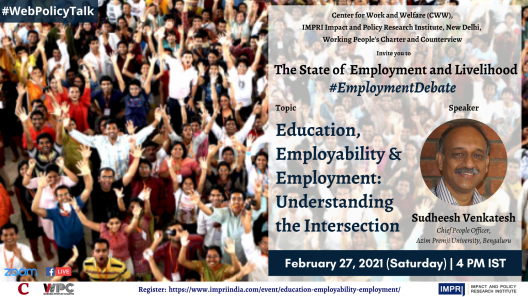
Sudheesh Venkatesh (Chief People Officer, Azim Premji University, Bengaluru) on Education, Employability & Employment: Understanding the Intersection
When: February 27, 2021; 16:00 IST (Saturday) | REGISTER HERE
|
|
|
|
#CityConversations
| |

|
Srikanth Viswanathan (Chief Executive Officer, Janaagraha Centre for Citizenship and Democracy) and Srinivas Alavilli (Lead, IChangeMyCity, The Civic Tech Platform of Janaagraha; Co-Founder, #SteelFlyoverBeda Movement) on The Status Quo in India’s Cities: How to break it?
When: March 1, 2021; 18:00 IST (Monday) | REGISTER HERE
Moderator: Dr Soumyadip Chattopadhyay (Visva-Bharati; IMPRI)
|
|
|
|
7th Prof Suresh Tendulkar Memorial Lecture
| |
|
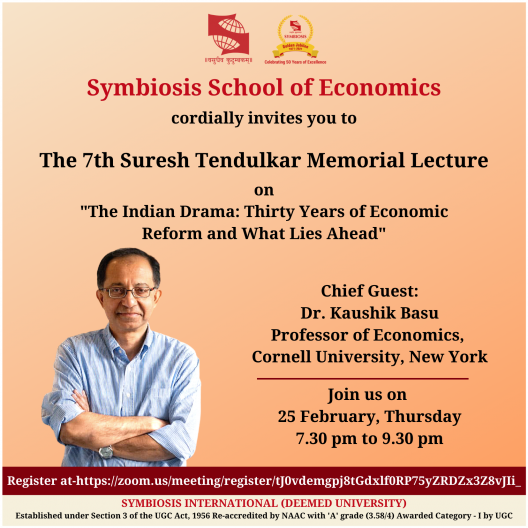
Symbiosis School of Economics cordially invites you for the Seventh Prof Suresh Tendulkar Memorial Lecture.
It will be delivered by Dr. Kaushik Basu, (Professor of Economics, Cornell University, Ithaca, New York). He will be speaking on "The Indian Drama: Thirty Years of Economic Reform and What Lies Ahead ".
When: February 25, 2021; 19:30 IST (Thursday) | REGISTER HERE
|
|
|
|
USIEF - Fulbright Program 75th Anniversary
| |

|
United States-India Educational Foundation (USIEF), New Delhi is organising a talk on “Political Participation and Representation of Women in India”, to be delivered by Fulbright-Nehru alumna Dr Simi Mehta, CEO and Editorial Director of IMPRI Impact and Policy Research Institute, Delhi.
This talk would assess:
1. The inherent and systemic patriarchy yielding to discrimination against women on the basis of stereotypical gender norms and roles.
2. The role of women in decentralized rural governance through PRIs.
3. Contrasting the policies (reserved seats) with the reality- some examples, and also explore their implications on socio-economic and environmental development.
4. Way forward
When: February 26, 2021; 16:00 IST (Friday) | REGISTER HERE
|
|
|
|
| |
|
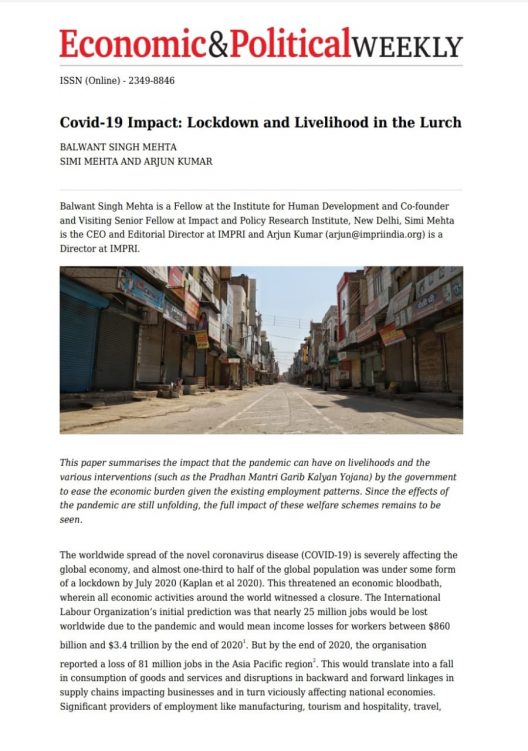
- 'Covid-19 Impact: Lockdown and Livelihood in the Lurch' by Balwant Singh Mehta, Simi Mehta and Arjun Kumar | Economic and Political Weekly
While the total aggregated amount announced for the benefit of its vulnerable sections appears to be huge, yet, per-person benefit comes out to be inadequate. Further, it is evident that the lockdown was put into place without having a well-crafted strategy, including the assured supply of essential commodities, services especially for medical care, kits, equipment, personpower and infrastructure preparedness as well as what happens to the poor and those who lose their livelihoods during this social distancing diktat and COVID-19 fears.
|
|
|
- 'Pro-Corporate Development Model ruining Uttarakhand' by Gurinder Kaur and Arjun Kumar | IndraStra Global
If mountainous areas of the country, including Uttarakhand and their people, are to be saved, then it is incumbent on the Central Government not to carry out development work in these areas without seeking geologists' and locals' opinions.
- 'Local Body Elections, Unsustainability of the Processes' by Tikender Panwar | IMPRI India
Except in a few, both urban and rural, elections to the local bodies passed off peacefully in Himachal Pradesh a few weeks ago. These elections were devoid of party symbols. But, while competing for zila parishad, major political parties announced their official candidates. However, a large number of independent candidates won in these elections. Two essential features require discussion and resolution for a healthy local body election in the future: the power of the ruling party and rampant use of money and resources.
- 'Pandemic and the Union Budget 2021: Implementation and the way forward' by Soumyadip Chattopadhyay, Arjun Kumar and Ritika Gupta | Counterview
Now that we are emerging from the shadows of the ill-planned lockdowns and inefficient bailout packages, the growth rates have still not returned to a healthy pace. We are also faced with new challenges of ensuring universal vaccination and the emergence of new variants of COVID-19. Given all these uncertainties, there is a need to focus on what the government can do, what the budget has done, and what it ought to have done: Prof Arun Kumar at an IMPRI #WebPolicyTalk
- 'Budget 2021 & Economic Reforms 2.0 towards New India' by Soumyadip Chattopadhyay, Arjun Kumar, Ritika Gupta, Anshula Mehta and Nishi Verma
“Interest rates are not a good instrument to control food and fuel inflation; there is a need to correct the overall macro framework for ensuring growth,” says Dr Dhiraj Nayyar.
- 'Overcoming trade imbalance in South Asia and IMF's post-COVID 'extreme optimism'' by Utpal K De and Simi Mehta | Counterview
Speaking at a #WebPolicyTalk, Prof Amita Batra pointed out that trade is usually studied as a standalone economic variable. It is the development potential that should be looked at as a key motivation for growing inter- and intra-regional trade.
- Budget 2021: A brief Analysis and Way Forward by Ms Malini Chakravarty – at IMPRI #WebPolicyTalk | IMPRI India
On the whole, the Budget saw a considerable slash in allocations to critical social and economic sectors. Ms Chakravarty lauded the increase in allocations to the Jal Jeevan Mission and the Swachh Bharat Mission. However, she expressed displeasure over the attempt to club this spending under the health vertical to show an increase of 137 percent for health, which is not the case.
- The Definition of Urban is very Stringent – Prof Jyoti Chandiramani at IMPRI #WebPolicyTalk| IMPRI India
Going forward, Dr Chandiramani emphasized the setting up of development finance institutions – DFI’s for facilitating long term infrastructure financing. Also, there is an urgent need to set up a bank on the lines of a National bank for Urban transformation and development, she suggested.
- India Needs Accountability, Clean Up of Politics and End of Cronyism – Dr Arun Kumar at IMPRI #WebPolicyTalk| IMPRI India
Dr Kumar noted that in the garb of promoting the concept of ‘Minimum Government, Maximum Governance’, the government is hellbent on its mission to dismantle the Public Sector. However, the pandemic has shown that the Public Sector is of critical importance. Rather than doing away with it completely, the government should focus on making them more efficient and accountable, he suggested.
- Budget 2021 Tries to Mask the Truth – Dr Jyotsna Jha at IMPRI #WebPolicyTalk| IMPRI India
Elaborating on this growth fetish, she added that while growth may lift people above the poverty line, it is indifferent to the concept of inequality and distress, which may still be widely prevalent considering that our definition of the poverty line is very conservative. The growth achieved may even be a jobless growth or a job loss growth, which does not address mitigating inequalities, she remarked.
- 'A Social-Ecological Approach to Urban Lake Governance and Sustainability in India' by Simi Mehta and Amita Bhaduri | IMPRI India
Biodiversity components should be included in ‘Detailed Project Reports’ of proposed surrounding infrastructure and nature’s elements – trees, the fish, or the birds - quantified. Investing accordingly and putting a price on wetlands services on top of the land price is also a noteworthy addition by Dr Mansee Bal Bhargava at an IMPRI #WebPolicyTalk
- 'When 85% Of Rural Women Work On Farms, Why Do We Think Of Farmers As Just Men?' by Simi Mehta, Anshula Mehta and Sunidhi Agarwal | Youth Ki Awaaz
National agricultural data sources do not provide information that can help us understand the extent of the gender gap, thus indicating a data challenge in agriculture. Agriculture lacks the data of activity-wise time use data. The data showing access to food in terms of availability and affordability disaggregated by sex does not exist which is inefficacious in identifying gender gaps: Prof Surabhi Mittal at an IMPRI #WebPolicyTalk
- 'Wet markets as pandemic’s epicentre' by Amita Singh | The Daily Guardian
Wet markets endanger not just exotic animal species and biodiversity, but also the human race at large—as has been proved by the Covid-19 pandemic, which originated in a Wuhan wet market and became one of the gravest disasters the world has seen. Yet, despite its many hazards, why can’t we seem to agree upon a worldwide ban on these markets?
- 'Urban Employment And Social Policy In The Wake Of COVID-19' by Soumyadip Chattopadhyay, Arjun Kumar, Sunidhi Agarwal, Ritika Gupta and Nikhil Jacob | Youth Ki Awaaz
Dr Amit Basole, at an IMPRI #WebPolicyTalk, cautioned that the Metro driven growth model is not the ideal way forward and instead a far more distributed pattern of growth and employment generation should be envisaged. There should be a focus on the small towns and cities as there is a serious undersupply of public goods. Increased creation of public employment is needed to provide the necessary services and to make the small towns dynamic job creators.
- 'Blurred Boundaries Of Women’s Work Amid COVID-19 Pandemic' by Ritu Agarwal | Youth Ki Awaaz
The twin burden of managing the households and, in many cases caring for small children and elderly parents has blurred the boundaries of women’s work. It is evident that regardless of the nature of work, women contributed significantly with their labour, professional skills, voluntary actions, and selfless dedication. Still, the caretakers were abused in the city.
- 'Lessons for Himachal Pradesh from Other Himalayan States' by Gurinder Kaur | The Citizen
Himachal Pradesh also falls in a seismically sensitive zone. The Indian and Arabian tectonic plates are constantly pushing India into the Eurasian plate, which is likely to cause major earthquakes from Jammu and Kashmir in the northwest to Mizoram in the northeastern region of the country.
|
|
|
| |
|
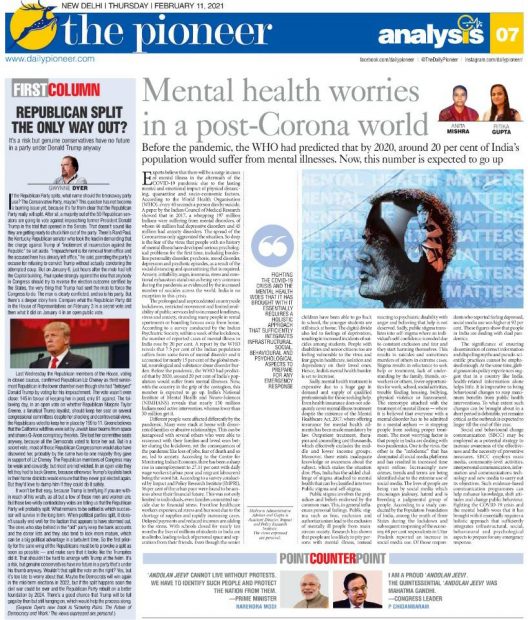
- 'Mental Health Worries in a Post-Corona World' by Anita Mishra and Ritika Gupta | The Pioneer
Before the pandemic, the WHO had predicted that by 2020, around 20 per cent of India's population would suffer from mental illnesses. Now, this number is expected to go up
|
|
|
|
| |
|
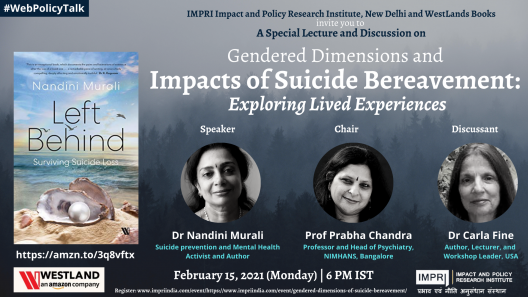
Special Lecture: Dr Nandini Murali (Suicide Prevention and Mental Health Activist; Author) on Gendered Dimensions and Impacts of Suicide Bereavement: Exploring Lived Experiences
Chaired by Prof Prabha Chandra (NIMHANS) with discussant Dr Carla Fine (Author, Lecturer, and Workshop Leader)
|
|
|
|
| |
|
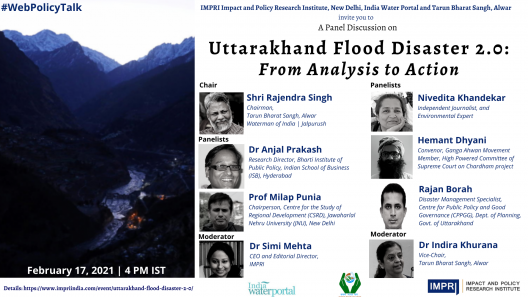
Panel Discussion: Uttarakhand Flood Disaster 2.0: From Analysis to Action
Chaired by Shri Rajendra Singh (Tarun Bharat Sangh, Alwar) and moderated by Dr Indira Khurana (Tarun Bharat Sangh, Alwar) and Dr Simi Mehta (IMPRI), the panel brought together Prof Milap Punia (Jawaharlal Nehru University, New Delhi), Nivedita Khandekar (Independent Journalist), Hemant Dhyani (Ganga Ahwan Movement), Rajan Borah (Department of Planning, Government of Uttarakhand) and Dr Anjal Prakash (Indian School of Business)
|
|
|
| |
| |
Looking forward to seeing you at a #WebPolicyTalk! |
|
| |
|
|
| |
| |
IMPRI, a startup research think tank, is a platform for pro-active, independent, non-partisan and policy-based research. It contributes to debates and deliberations for action-based solutions to a host of strategic issues. IMPRI is committed to democracy, mobilization and community building. |
|
| |
|
|
|


